
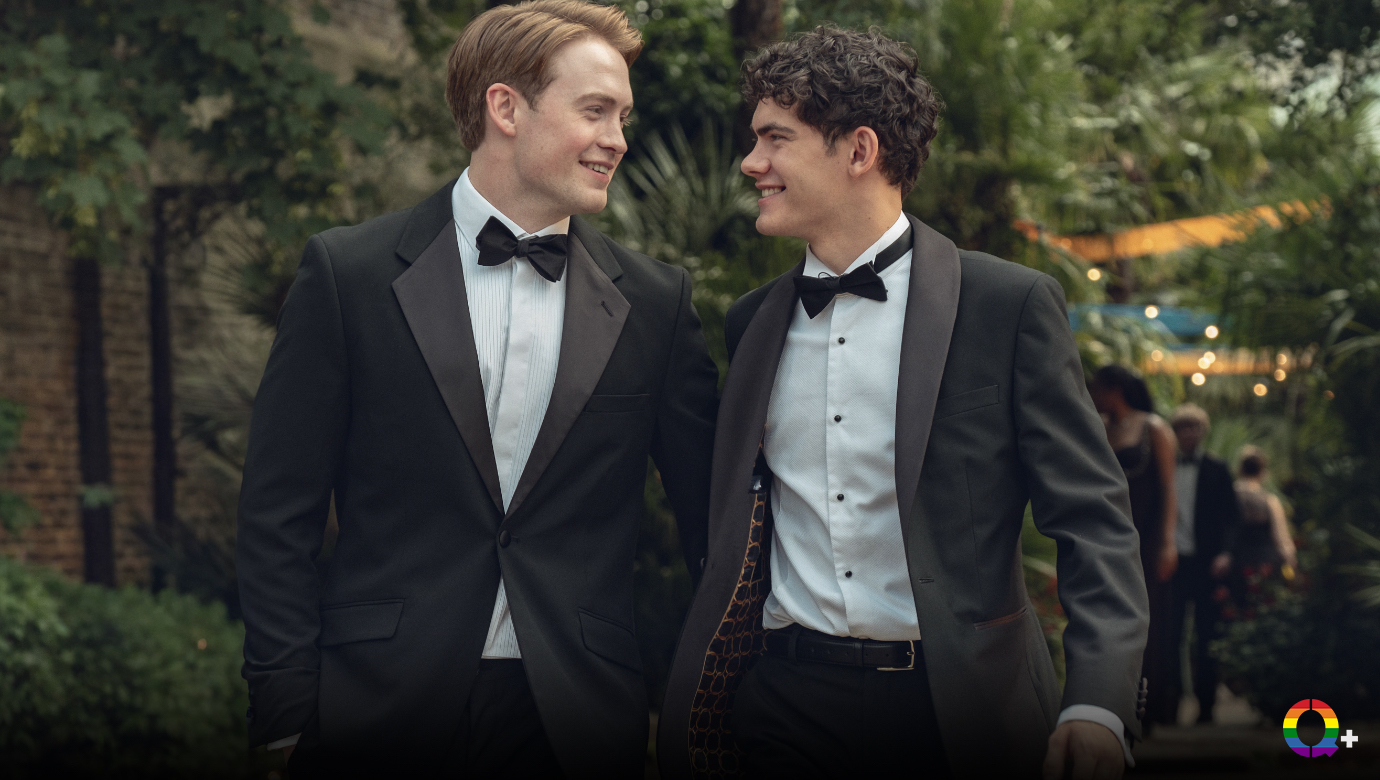
Heartstopper Forever Review: The Future We Deserve to Imagine
Some reviews come together almost effortlessly. Others ask us to pause, gather our thoughts, and somehow find the right words for something that has become much bigger than a television show. Heartstopper Forever is one of those reviews.
Not because it’s difficult to judge as a film, but because it’s almost impossible to separate Heartstopper itself from the emotions that inevitably accompany its farewell. We don’t often get to watch a story redefine the expectations of an entire genre in real time. Yet over the past four years, that’s exactly what Alice Oseman’s story has accomplished.
This isn’t to say queer coming-of-age stories didn’t exist before Heartstopper. They did, and many remain essential chapters in LGBTQ+ television history. Most told stories of first loves interrupted by intolerance, lives cut short by violence or disease, and relationships forced into secrecy before collapsing beneath the weight of a world unwilling to make room for them. Those stories have always mattered. They gave voice to pain that had long been ignored and preserved histories that might otherwise have been forgotten.
What Heartstopper added to that conversation was something equally essential: the belief that tenderness could be just as revolutionary.

Representation doesn’t become richer by telling the same story over and over again. It grows by making room for different experiences. Not every queer teenager finds their Nick (Kit Connor) or their Charlie (Joe Locke). Many never receive the support these characters do. But many others do build loving friendships, accepting families, healthy relationships, and futures they once believed impossible. Those stories deserve to exist too. They remind younger audiences that happiness isn’t an exception reserved for somebody else.
That may ultimately be the defining strength of Heartstopper Forever, the feature-length conclusion to Netflix’s beloved adaptation of Oseman’s graphic novels. Rather than ending where so many coming-of-age romances do, it dares to explore what happens after happily ever after. What it finds is neither fairy tale nor tragedy. It is simply life.
Television has taught us countless ways for young love to fail. Distance. Graduation. University. Growing apart. Cheating. The assumption that first love is merely practice for something more permanent later in life. Those expectations have become so deeply embedded in popular culture that we often accept them without question. Heartstopper Forever invites us to consider a different possibility where growing up doesn’t necessarily have to mean growing apart.

For three seasons, Heartstopper has become one of the defining queer stories of its generation not because it ignored hardship, but because it refused to let hardship become the only lens through which queer love could be understood. Charlie’s eating disorder, Nick’s journey toward embracing his bisexuality, Tao (Will Gao) and Elle’s (Yasmin Finney) insecurities, Isaac’s (Tobie Donovan) discovery of his asexuality, Darcy’s (Kizzy Edgell) struggles at home, Tara’s (Corinna Brown) anxiety, Imogen’s (Rhea Norwood) evolving understanding of herself—these stories never pretended that growing up was easy.
What the series insisted on, however, was something television has too often denied queer audiences: that tenderness deserves just as much narrative weight as trauma. Softness can coexist with struggle. Joy can exist alongside fear. Hope deserves the same artistic legitimacy as heartbreak. Some have dismissed that perspective as naïve, overly sweet, or hopelessly rose-tinted. We’d argue that’s precisely why it matters.
Heartstopper Forever carries that philosophy confidently into its final chapter. From its opening moments, the film understands exactly what it means to the audience that has grown alongside these characters. Instead of simply revisiting familiar moments for nostalgia’s sake, it acknowledges the passage of time as its central dramatic force. We aren’t merely returning to Nick and Charlie’s world; we’re confronting how much they’ve changed—and, perhaps, how much we have too. That sense of transition shapes the entire film.
University applications replace GCSEs. Gap years become genuine possibilities rather than distant dreams. Careers begin to take shape. Relationships that once existed almost entirely within school corridors suddenly have to survive jobs, deadlines, and the prospect of living hundreds of miles apart. The future, once an exciting abstraction, suddenly feels immediate.
Appropriately, Heartstopper Forever knows that adulthood doesn’t arrive with certainty. It arrives with questions.

No character embodies that uncertainty more profoundly than Nick. For much of the series, he has been its emotional anchor, standing beside Charlie through bullying, mental illness, recovery, and self-discovery with unwavering devotion. It would have been easy for the film to simply repeat that dynamic. Instead, it challenges the character in a far more interesting way: who is Nick when Charlie no longer needs saving?
It is a compelling piece of character writing because the crisis is almost entirely internal. Charlie has grown into someone remarkably secure in himself. His confidence is no longer measured by survival but by what he can offer others. He steps naturally into leadership, advocates for younger students, and begins using his own experiences to make school a kinder place for the people coming after him. Healing, Heartstopper Forever suggests, is about transforming pain into compassion and survival into purpose.
Nick, meanwhile, finds himself emotionally stranded. Unable to articulate his fears, increasingly anxious about university, and quietly convinced that his value exists only in protecting the person he loves, he begins withdrawing into himself. His anxiety, insecurity, and growing emotional distance aren’t presented as moral failings, but as the inevitable result of someone who has spent so long defining himself through caring for others that he no longer knows who he is without that role.
Nick’s uncertainty becomes the foundation for what may be Heartstopper Forever’s most mature observation: communication isn’t something healthy couples either possess or lack. It’s a skill—one that has to be practiced, protected, and sometimes painfully relearned.
Throughout the film, Nick and Charlie speak about the importance of honesty while simultaneously struggling to achieve it themselves. Together, they create one of the most emotionally authentic portrayals of young love we’ve seen in years. Their misunderstandings don’t stem from betrayal or dramatic revelations, but from two people desperately trying to protect each other while speaking entirely different emotional languages.
It’s one of the rare cinematic relationships where conflict doesn’t exist because love has disappeared. It exists because love is still very much there. Watching Nick and Charlie become trapped inside fears neither quite knows how to name is heartbreaking precisely because neither of them is wrong. They’re simply growing up. And Heartstopper Forever understands that becoming an adult often means discovering feelings long before discovering the language needed to express them.

That emotional generosity extends far beyond Nick and Charlie’s relationship. One of Heartstopper‘s greatest strengths has always been its understanding that coming of age is rarely something we do alone. Tao, Elle, Isaac, Tara, Darcy, Imogen, Tori (Jenny Walser), and even Michael (Darragh Hand) are never treated as supporting players who exist solely to orbit Nick and Charlie. Each is allowed to grow with sincerity, carrying a story that feels fully their own.
A fourth season would undoubtedly have offered more time to continue exploring each of those journeys. As a feature film, however, Heartstopper Forever wisely accepts that its focus must become more intimate. This is, above all else, the conclusion of Nick and Charlie’s story. Their friends remain an essential part of that journey, but the emotional centre belongs to the relationship that first invited us into this world.
Even so, the supporting cast continues to enrich the film in meaningful ways. Tao and Elle’s relationship becomes a thoughtful counterpoint to Nick and Charlie’s, reminding us that love alone doesn’t always answer the practical questions adulthood demands, and different relationships demand different futures. Isaac once again delivers some of the screenplay’s strongest moments of wisdom, while Tori and Michael offer a refreshingly understated exploration of a relationship that exists entirely on its own terms, gently broadening the series’ already thoughtful approach to LGBTQ+ representation.
Those stories all point toward the same idea: growing up isn’t about arriving at a single definition of love. It’s about discovering the version that makes sense for you.
Rather than treating adulthood as a destination, Heartstopper Forever presents it as an ongoing conversation—one filled with uncertainty, vulnerability, compromise, and the uncomfortable realization that loving someone doesn’t exempt either of you from continuing to grow as individuals. The film understands that love alone doesn’t solve every problem, but it refuses to diminish love simply because its characters are young.

It’s also impossible to discuss Heartstopper Forever without acknowledging its willingness to engage directly with the realities facing the LGBTQ+ community today. One of the film’s most affecting moments arrives not through romance, but through Elle’s impassioned explanation of why Pride still matters. Speaking openly about the increasingly hostile climate facing trans people in the United Kingdom, she reminds us that queer joy has always existed alongside queer struggle. That joy doesn’t erase the wider battles still being fought for equality, dignity, and the simple right to exist.
That balance has always been one of Heartstopper‘s defining strengths. Its optimism has occasionally been dismissed as unrealistic, as though kindness somehow makes a story less truthful. We’d argue the opposite. Optimism isn’t the absence of hardship; it’s the refusal to believe hardship is the only possible ending.
Heartstopper has never pretended that homophobia disappeared. It has never suggested that mental illness ends with a declaration of love, that coming out guarantees acceptance, or that growing up queer suddenly becomes easy. Fear, rejection, loneliness, and uncertainty remain very real parts of these characters’ lives.
What changes is the conclusion the story draws from those experiences. Instead of insisting that suffering defines queer existence, Heartstopper Forever continues the series’ belief that healing can define it too. That is not escapism: it is possibility.
Not because every queer story should resemble Heartstopper. They shouldn’t. Queer storytelling is at its strongest when it embraces every possible experience—joy, grief, anger, romance, comedy, heartbreak, triumph, and everything in between. But hopeful stories deserve the same artistic legitimacy as painful ones because hope tells the truth too.

By the time Heartstopper Forever reaches its final act, its emotional focus has shifted. It is no longer concerned with whether first love can survive distance or adulthood. Instead, its true subject is the slow, ongoing work of building a life with another person.
Love isn’t presented as destiny, or some magical force that guarantees two people will stay together simply because they’re meant to be. It’s something far more demanding and, ultimately, far more hopeful: a choice. A decision to keep showing up, to keep listening, to keep growing alongside another person, even when life becomes complicated. That idea becomes the emotional foundation of the entire film.
That perspective is especially powerful within the context of Nick and Charlie’s love story. There is something profoundly moving about watching queer love framed not as an inevitable tragedy or a miraculous exception, but as an ordinary, enduring commitment. Heartstopper Forever reminds us that the greatest romances aren’t sustained by grand gestures alone, but by countless small decisions to understand one another, to forgive, to grow, and to keep choosing each other through every new stage of life.
That idea is beautifully reinforced by one of the story’s most unexpected parallels. An elderly queer couple (played by Sir Derek Jacobi and his longtime real-life partner, Richard Clifford), whose relationship has long since settled into the comforting rhythm of everyday life, quietly demonstrates what enduring love really looks like. Their conversations aren’t about sweeping romantic gestures or dramatic sacrifices. They’re about hospital visits, solving crosswords, looking after one another, and the small routines that slowly become a shared life.
Perhaps that’s the greatest act of imagination Heartstopper has ever offered. Not perfect love, but ordinary happiness. The freedom to imagine queer adulthood filled with Sunday breakfasts, inside jokes, family visits, photographs on bedroom walls, grocery shopping, quiet evenings on the sofa, arguments that end with understanding instead of devastation, and decades of memories still waiting to be made.

For many older queer viewers, there is an undeniable poignancy in that vision. Entire generations grew up surrounded by stories in which queer characters existed primarily to suffer, educate straight audiences, or disappear before they ever reached adulthood. Heartstopper cannot rewrite those histories, nor should it try. What it can do is offer something many of us never had: a story where younger generations recognize themselves before they recognize their trauma.
A story where coming out isn’t the finish line. Where recovery is possible. Where therapy is normal. Where bisexuality, asexuality, and trans identities exist without requiring explanation. Where friendship lasts. Where family can grow. And where two boys are allowed to imagine growing old together without the narrative apologizing for believing they might.
For all the weight carried by its ideas, Heartstopper Forever never forgets that its greatest strength has always been the people bringing them to life. One of the quiet achievements of this adaptation is that its performers have spent four years growing alongside these characters. That shared passage of time lends the film an authenticity that simply cannot be manufactured.
Kit Connor and Joe Locke deliver some of the strongest work of the entire series. Their chemistry has always felt less like television romance than genuine familiarity—the kind that only comes from years of growing alongside one another both on screen and off. Heartstopper Forever trusts that chemistry completely. Rather than leaning on grand speeches or melodramatic confrontations, it allows hesitant silences, lingering glances, awkward laughter, and everyday routines to carry the emotional weight. The result is a relationship that never feels performed so much as lived.

Behind the camera, the film retains the visual identity that has made Heartstopper instantly recognizable from the beginning. Warm natural lighting, gentle color palettes, intimate framing, and a soundtrack that once again understands exactly when to step forward and when to quietly disappear all combine to create a world that remains comforting without ever feeling artificial.
There is an understated confidence to the filmmaking that reflects the maturity of the story itself. Director Wash Westmoreland never overwhelms the emotional material with stylistic excess, understanding that the performances are the film’s greatest special effect. The whimsical flourishes that once illustrated the butterflies of first love gradually give way to something more restrained, allowing the performances and emotional honesty to take center stage without ever sacrificing the warmth that made audiences fall in love with Heartstopper in the first place.
And perhaps that’s why Heartstopper Forever will endure long after its closing scene. Very few television stories genuinely alter the landscape of queer representation. Fewer still manage to do so without compromising either their kindness or their honesty. Heartstopper accomplished something increasingly rare: it became a cultural touchstone without sacrificing its sincerity. It never hardened itself in pursuit of prestige or irony. Instead, it trusted that kindness could be compelling enough on its own.
Whether viewers connected with Nick and Charlie because they saw themselves reflected on screen, or because they simply wished they had grown up with stories like this, Heartstopper has always understood that representation is about possibility as much as recognition. It never tried to convince us that every queer love story looks like this one. It simply insisted that stories like this deserve to exist alongside every other version of queer life.
That is why Heartstopper will continue to matter. Not because it reinvented romance. Not because it ignored tragedy. But because it dared to believe that kindness was just as worthy of our attention as suffering.

For many of us, this story arrived years too late to change our adolescence. We had already grown up. We had already stumbled through first loves, heartbreaks, closets, loneliness, and all the uncertainty that comes with trying to build a life in a world that rarely tells queer people they’ll get to have one. And yet, somehow, Heartstopper still found us. It reminded us that healing doesn’t always come from rewriting the past. Sometimes it comes from finally seeing the future we were never allowed to imagine.
That’s the real legacy of Heartstopper Forever. Not simply that it gives Nick and Charlie an ending worthy of the journey they’ve shared, but that it refuses to treat that ending as the end of the conversation. Instead, it leaves them exactly where life leaves all of us: with empty pages still waiting to be filled.
And perhaps that’s fitting.
Four years ago, all it took was a shy “Hi” between two classmates for an extraordinary story to begin. Today, after three seasons and one beautifully heartfelt farewell, that greeting carries a different meaning. It reminds us that love rarely arrives through grand cinematic moments. More often, it begins with ordinary acts of courage. Saying hello. Telling the truth. Listening instead of assuming. Choosing kindness. Choosing vulnerability. Choosing to stay. Choosing each other. Leaning toward love.
That’s the choice Nick and Charlie continue making. It’s the choice Heartstopper has asked its audience to believe in from the very beginning: that love isn’t something we simply find and then hold onto unchanged, but something we choose, nurture, and return to every single day. And in a world that has spent far too long telling queer people their stories are destined to end in silence, separation, or tragedy, there is something profoundly moving about a film that chooses to end with hope. Because hope, like love itself, isn’t something we’re promised. It’s something we keep choosing.
And perhaps that’s why saying goodbye to Heartstopper feels so difficult. Not because the story is ending, but because it reminded us that the future isn’t something queer people should have to earn. It’s something we’ve always deserved to imagine. That’s what Heartstopper Forever leaves behind: the confidence to believe that our stories are worthy not only of survival, but of joy, tenderness, and tomorrow.
Heartstopper Forever is now streaming globally exclusively on Netflix. Seasons 1-3 of Heartstopper are available to stream on Netflix too. Follow us on X and Instagram for all queer stuff!
Featured Image: Image Courtesy of Netflix.
Discover more from Q+ Magazine
Subscribe to get the latest posts sent to your email.


Pingback: Heartstopper Forever Soundtrack: Every Song Featured in the Film – Q+ Magazine