
‘Almost Us’ Review: A Queer Story with Heart, Hitting Just Shy of Its Potential
Independent queer cinema has always been a space where stories that rarely get the spotlight can exist, breathe, and push forward. With Almost Us, writer, director, and star Anthony Bawn sets out to tell a story that blends romance, gentrification, power, and the fragile spaces queer people call home. And while the film undeniably carries ambition, and the intention behind it is clear, the execution leaves us somewhere in the middle.
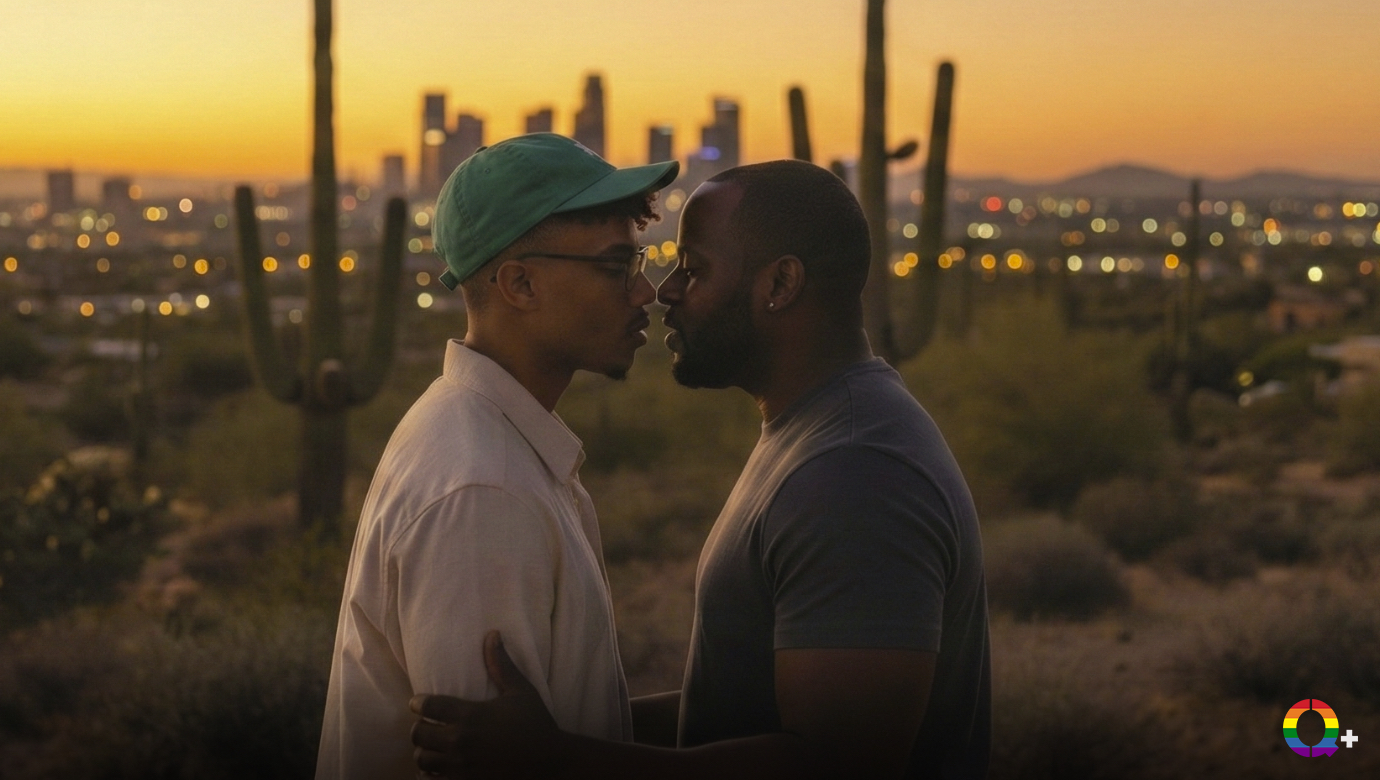
Almost Us follows Jason (Bawn), a charismatic yet messy community organizer fighting to save the Baldwin Cultural Center, and Darren (Adri Kennedy), a closeted real estate developer whose family company is threatening to tear that very space down. What begins as a one-night stand quickly spirals into something far more complicated, where attraction, negotiation, strategy, and survival all blur together.
On paper, it’s the kind of story that feels rich with potential. A queer romance entangled in systemic power? A Black-led narrative about protecting community spaces in the face of gentrification? That’s the kind of storytelling we need more of. And Almost Us clearly understands that. There are glimpses throughout the film where its themes land with clarity, particularly when it focuses on what the Baldwin Cultural Center represents. It’s not just a building; it’s a lifeline, a gathering place, a symbol of resistance. It’s where culture lives, where people connect, and where identity is nurtured. That aspect of the film works, and it matters.
But where Almost Us struggles is in its execution.

There’s a noticeable roughness that suggests the film could have used more polishing. Its structure feels uneven, often dropping us into scenes without enough context to ground us. Characters come and go before we fully understand who they are or how they fit into the bigger picture. There’s a sense that we’re constantly catching up, trying to piece together motivations and dynamics that the film doesn’t fully flesh out.
Then there’s the question of genre. The film is positioned as a romantic comedy, but it rarely leans into either of those elements in a way that feels satisfying. The romance between Jason and Darren, which should be the emotional backbone, doesn’t fully land. Their connection feels more symbolic than emotional, making it harder to truly invest in their journey. The humor, too, is so subtle it’s almost absent, leaving the film hovering in a tonal space that feels closer to a subdued drama than a rom-com.
The dialogue adds to that distance. Some exchanges feel overly scripted, which can pull us out of the moment rather than grounding us in it. And while the film clearly wants the audience to read between the lines, it occasionally asks for more effort than it gives back.
And yet, despite these shortcomings, we can’t ignore what Almost Us is trying to do, and why that matters.

There’s something undeniably important about seeing a film that places Black queer characters at the center of a story about power, class, and survival. It moves beyond the coming-out narrative and into more complex, morally gray territory. It’s about legacy, about the cost of survival, and about the uncomfortable choices people make when systems are stacked against them. And even when the film doesn’t fully stick the landing, those themes remain important and resonate, opening the door for stories like this to keep evolving.
It also gives us characters who exist in complicated spaces without falling into overused tropes, particularly when it comes to people of color. Jason’s fight isn’t just personal, it’s communal. He’s not only navigating a messy romantic entanglement, but he’s also trying to protect a space that represents hope for others. Darren’s struggle, meanwhile, isn’t just about sexuality—it’s about expectation, legacy, and the cost of maintaining an image. Those layers are meaningful, even if the film doesn’t always explore them with the depth or clarity they deserve.
And maybe that’s where Almost Us ultimately lands: in that “almost” space its title suggests. It’s not a complete miss, but it’s not a fully realized hit either. It’s almost a romance, almost a comedy, almost a fully formed drama. It doesn’t quite come together in the way it intends, but that doesn’t mean it’s without value. There’s enough here to recognize both its ambition and its potential. It’s a film with something to say, even if it struggles with how to say it.
Almost Us is a reminder of why independent queer cinema—especially from Black creators—deserves our attention and support. These stories matter. These perspectives matter. And platforms like WatchVIM, where the film is available to stream, are creating space for voices that too often go unheard.
So while Almost Us may not fully deliver on its ambitions, it still sparks a conversation. And sometimes, that’s a meaningful place to start.
Almost Us is available to stream on WatchVIM now. Follow us on X and Instagram for all queer stuff!
Featured Image: Image Courtesy of WatchVIM.
Discover more from Q+ Magazine
Subscribe to get the latest posts sent to your email.


Pingback: Pride 2026: A Q+ Celebration – Q+ Magazine