
‘Screams From the Tower’ Review: Tuning Into a Queer Coming-of-Age Frequency
There’s something instantly disarming about Screams From the Tower. From the moment it drops us into the late summer of 1995, it becomes clear that writer-director Cory Wexler Grant isn’t just recreating a time period, but interrogating, and dare we say, reclaiming a genre. It’s an invitation into a world that feels both distant and deeply familiar. It’s a pre-digital landscape of cassette tapes, school radio stations, and hallway whispers, but more importantly, a world where two boys are trying to figure out who they are.
The film quickly and very openly positions itself in conversation with the coming-of-age classics of the ‘80s and ‘90s, evoking the spirit of many of them. But instead of simply echoing their tone or structure, it asks a pointed question: what happens when the emotional center of those classics shifts toward queer identity? What happens when that familiar framework—the cliques, the teachers, the awkward romances and crushes, the slow realization that high school is both everything and nothing all at once—centers on two closeted (or not-so-closeted) queer boys?
The answer unfolds through Cary (David Bloom) and Julien (Richie Fusco), two best friends whose chemistry is immediate and convincing, but whose internal landscapes couldn’t be more different. Cary moves through the world with caution, curating a version of himself that aligns with expectation, while Julien operates with a kind of instinctive openness—messy, ambitious, and often contradictory within his own boxed reality. That contrast doesn’t just define their dynamic, it becomes the engine of the film’s tension.

What’s particularly striking is how Screams From the Tower reframes familiar coming-of-age beats without leaning on the more sensationalized elements often associated with queer coming-of-age stories. There’s no singular moment of trauma that dictates the story’s trajectory. Instead, the film leans into something softer, more universal: the quiet chaos of growing up. And while there is conflict, the story is less about suffering and more about becoming. About figuring yourself out in real time, about finding your voice, quite literally, in this case.
The 1990s setting plays a crucial role here. Grant’s depiction of an “analogue world” isn’t just aesthetic; it shapes how these characters experience themselves and each other. Without the language, visibility, or digital communities that exist today, Cary and Julien are left to interpret their feelings in isolation or within the limited frameworks available to them. Cary’s insistence on a heterosexual relationship reads less like deception and more like survival, while Julien’s relative freedom feels both liberating and precarious. He can express himself, but not always out loud.
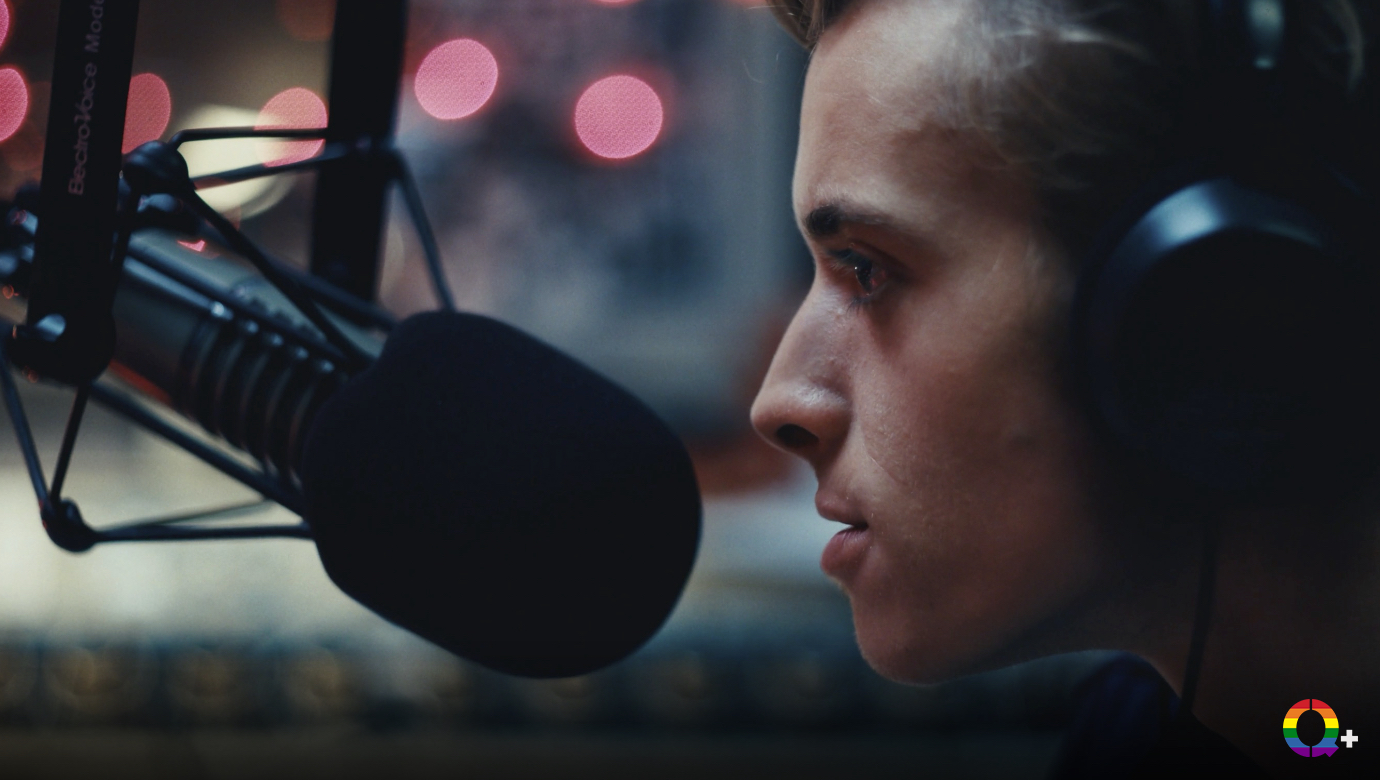
That’s why the school radio station, the WNFH, becomes a fascinating site of negotiation. It’s a structured environment, governed by rules and authority, yet it offers the illusion of freedom. For Julien, especially, it’s a controlled space where he can construct identity on his own terms. The show he builds with Cary—Screams From the Tower—ends up carrying the film’s emotional progression, evolving alongside them as they grow, fracture, and try to find themselves.

And yes, that title carries a special meaning. It reflects what it’s like to exist inside a teenage mind, where everything feels loud, urgent, and impossible to contain, like you’re screaming from inside your own head, hoping someone out there is listening. Julien’s evolution as a host—from chaotic improvisation to the creation of personas like Miss Yolanda—mirrors that impulse, revealing a deeper need to mediate how he’s perceived. Performance becomes both shield and outlet, a way to process what he can’t yet fully articulate off-air.
That duality is also evident in the film’s handling of Julien’s OCD. Rather than isolating it as a separate narrative thread, the film integrates it into his broader experience of control, anxiety, and self-expression. His compulsions aren’t reduced to quirks; they actively shape how he navigates school, relationships, and even his creative work. The radio booth, in that sense, functions as a counterbalance: a space where unpredictability is allowed, even encouraged, within a system he understands. All of it speaks to the ways queer kids have historically carved out spaces for themselves when the real world felt too overwhelming to navigate.
Richie Fusco’s performance is key to making all of this work. He carries Screams From the Tower with a kind of effortless magnetism, bringing a level of precision to Julien that keeps the character from tipping into caricature, even at his most heightened. There’s a constant negotiation in his portrayal—between confidence and insecurity, humor and deflection—that makes Julien feel fully rounded. The film’s structure, which increasingly centers his perspective, only amplifies the impact of that performance.
David Bloom, meanwhile, takes a more restrained approach as Cary, which works in the film’s favor. His internal conflict is less verbalized but consistently present, particularly in moments where his constructed identity begins to falter. The interplay between Bloom and Fusco gives the film some of its strongest scenes, especially as their friendship begins to fracture under the weight of diverging paths and unacknowledged truths.

That friendship, in fact, is where the film finds much of its thematic resonance. Not in a sentimentalized sense, but as a space where identity is both explored and contested. Cary and Julien don’t simply support each other, they challenge, misunderstand, and, at times, hurt one another. Their connection resists easy categorization, existing in a liminal space that reflects the fluidity of their experiences. The film doesn’t rush to define it, and that restraint allows for a more honest depiction of how relationships like this can shape, and at times complicate, self-discovery.
Grant describes the film as a love letter to his best friend, and that intention is felt in every frame. There’s a tenderness here, a sincerity that refuses to become cynical. Even when the characters hurt each other (and they do), the film approaches them with empathy. It understands that growing up sometimes means growing apart, but it also suggests that those connections leave an imprint that doesn’t fade. Their final scenes together, layered with love, regret, and everything left unsaid, are some of the film’s most affecting. We feel the history between them. We feel the loss. And we feel the possibility, however uncertain, of what comes next.
Grant’s intention to create a story that feels widely relatable, regardless of identity, is evident, but it never comes at the expense of specificity. The film remains grounded in queer experience, particularly in how it captures the dissonance between internal truth and external performance. At the same time, its focus on creative ambition, academic pressure, mental health, and the fear of an uncertain future broadens its emotional accessibility.

By the time the film reaches its final stretch, there’s a noticeable shift in tone. The humor and chaos that defined earlier sequences give way to something more reflective, without losing the character’s voice. Julien’s closing moments—on air and off—don’t offer neat resolution, but they do signal a form of self-recognition. Not a complete understanding, but a willingness to exist without apology.
And that in itself is a reminder that being weird, being “too much” might just be the point. That being loud and different isn’t something to shrink away from, but something to hold onto. That sometimes, the bravest thing you can do is speak, even when your voice is shaking.
Screams From the Tower then ends up functioning as both homage and revision. It borrows the framework of a well-worn genre, subtly reconfiguring it to center voices that were historically pushed to the margins. In doing so, it doesn’t just revisit the past, but reframes it, suggesting that these stories have always had more to say than they were allowed to.
Screams From the Tower may be set in the ‘90s, but its message resonates just as strongly today. Because while the landscape for LGBTQ+ youth has changed, that core experience—the confusion, the fear, the longing, the joy of finding your people and your voice—remains universal. And in giving us a story that feels both specific and widely relatable, Cory Wexler Grant has created something special: a film that doesn’t just ask us to listen, but to really hear each other.
Screams From the Tower is available on VOD including Apple TV, Prime Video, and Fandango at Home. Follow us on X and Instagram for all queer stuff!
Featured Image: Image Courtesy of TLA.
Discover more from Q+ Magazine
Subscribe to get the latest posts sent to your email.


Pingback: Pride 2026: A Q+ Celebration – Q+ Magazine