Color Theories: A Guide to Seeing the World, According to Julio Torres
Maybe we sound like a broken record at this point, but that doesn’t make what we’re about to say any less true. Every time we get the chance to experience Julio Torres’ work, we’re left staring into the middle distance, wondering how his mind even arrives at these ideas—how his brain even works. There’s something so distinctly him about the way he processes the world that it almost feels like he’s operating on a completely different wavelength: one that’s surreal, hyper-specific, and yet, somehow, universally understood. It’s the kind of brilliance that doesn’t just impress us, but gently unsettles us, making us question our own creative instincts, our own ways of seeing.
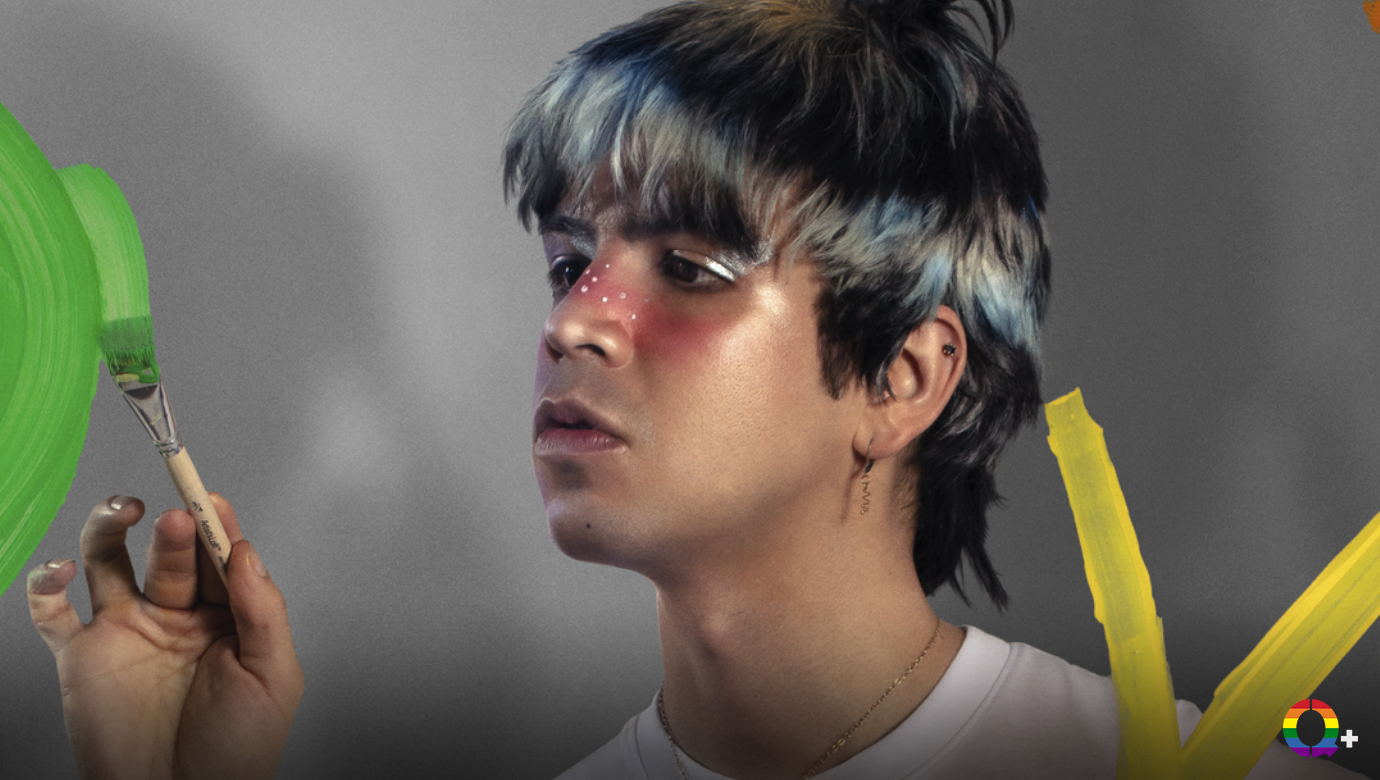
With Color Theories, Julio doesn’t just return to that wavelength, he expands it. This HBO special is not only another standout entry in his ever-growing catalog, but it’s one we find ourselves fully obsessed with. Maybe it’s because, as an LGBTQ+ publication, the language of color is already embedded in how we understand identity and community. Maybe it’s because there’s something inherently artistic about the way Julio constructs meaning here. Or maybe it’s because this special feels like an artistic playground that invites us to engage, interpret, and question. Either way, by the end of it, we found ourselves thinking about how to unlearn a little bit of our navy-blue instincts and embrace something more fluid… more green, more orange, more yellow, more… everything.

From its opening moments, Color Theories makes it clear that we’re not in for a traditional comedy special, and Julio is not interested in following a conventional stand-up structure. Instead, he introduces us to a collection of objects—almost like a theatrical ensemble—before emerging from a literal hole, as if he’s being born into his own framework. It’s absurd, yes, but it’s also intentional. This is a world with its own internal logic, and Julio is both our guide and its most curious inhabitant.
He sets the rules early on: when he refers to color, he’s not speaking literally, nor spiritually, but conceptually and energetically. And what’s remarkable is how quickly we get it. When he says the sound of rain is green (accompanied by the soft hum of rainfall and a wash of green light across the stage), we don’t question or resist the idea—we feel it. We understand it. Not intellectually, but instinctively. That’s the quiet genius of Color Theories: it builds a language that bypasses logic and goes straight for recognition.
As the special unfolds, colors become emotional and social codes. Yellow becomes joy, but not just any joy—manufactured, performative joy, the kind that smiles a little too hard. Orange becomes the perfect midpoint between rage and childlike wonder, which Julio cleverly maps onto public figures we collectively deem “safe,” people who are exciting, but not dangerous. Red simmers beneath the surface, raw and volatile. And suddenly, we’re not just laughing, we’re analyzing how we assign meaning to people, to systems, to entire identities.
And that’s where the show starts to reveal its deeper layers. Because while Color Theories is brilliantly hilarious (and we mean that quite literally: brilliant and funny), it’s also cleverly radical. Julio’s breakdown of “navy-blue” as the dominant force shaping our world is both comedic and cutting. Navy-blue isn’t just a color; it’s bureaucracy, systems of control, the rigid structures that demand conformity. It’s the insistence on RSVP-ing through a website after already saying yes. It’s airports, rules, institutions. It’s the quiet policing of behavior disguised as order.

As a queer artist, Julio’s framing of navy-blue feels especially resonant. There’s an inherent queerness in the way he challenges these structures, not through confrontation, but through reclassification. He doesn’t tear systems down, he redefines them in a language that exposes their absurdity. And in doing so, he invites us to question them too. The insistence that there is a correct way to exist, to behave, and to respond becomes impossible to ignore. By framing these ideas through this color, Julio doesn’t just critique them, but exposes how arbitrary and constructed they really are.
Green, on the other hand, emerges as something almost utopian. It’s comfort, curiosity, instinct. It’s crossing the street in Hanoi without rigid traffic rules, trusting in a shared human understanding. It’s learning for the sake of learning, exploring, and existing outside of imposed systems. But Julio is careful not to romanticize it entirely, because as he shows, navy-blue is always looming, ready to structure it, to contain it, to “correct” it. And what happens when green gets trapped inside navy-blue? It turns red.
It’s one of the many moments in Color Theories where the humor lands almost simultaneously with a deeper realization. Julio’s commentary on how systems co-opt and reshape behavior—particularly in cultural and political contexts—feels both specific and universal. And that’s what makes Color Theories so effective because it constantly shifts tone without ever losing its thread. It moves from playful observations about letters (which, canonically, are queer and living their best chosen-family lives) to biting commentary on capitalism, immigration, and cultural identity. It’s a delicate balance, but Julio maintains it effortlessly, blending the whimsical with the political in a way that feels distinctly his.

One moment we’re laughing at the absurdity of reviewing a waterfall on Google Maps (a very navy-blue concept), and the next we’re sitting with the implications of what it means to quantify and critique something that simply exists. And then, just as we start to feel comfortable within this framework, Julio introduces disruption in the form of Bibo, his small robot companion.
At first, Bibo feels like a comedic sidekick—a quirky, slightly chaotic presence keeping the show on track. But as the special progresses, Bibo becomes something much more significant: a counterpoint. A mirror. When Julio gets too deep into his own framework, too convinced of his classifications, Bibo challenges him. He forces him (and us, by proxy) to confront the limitations of the very system he’s created.
And that’s where Color Theories truly evolves.
Because just when we’ve settled into understanding this color-coded world, the show pulls the rug out from under us. Bibo introduces the idea that maybe these color theories, however insightful they can be, are still limiting—are still a system of categorization. That reducing people, systems, and emotions into neat categories might not be all that different from the rigid structures Julio critiques. And that realization shifts everything.

In its final act, Color Theories stops being about defining the world and starts being about questioning the need to define it at all. It’s a striking shift, and one that lands with emotional clarity. Julio admits that he’s been “very Real Housewife” (someone red but squeezed in a navy-blue packaging), consumed by his own perspective—boxing things in because he himself feels boxed in. It’s a moment of vulnerability that reframes everything we’ve just seen.
And from there, the special transforms. What starts as Color Theories: A Guide to Seeing the World becomes Color Theories: An Invitation to See. Instead of a rigid book of definitions, Julio imagines something more fluid, something alive. A pond where colors swirl, interact, and evolve. A space where nothing exists in isolation, where every experience is shaped by what came before and what comes after. Where understanding isn’t about labeling, but about observing, listening, and connecting.
It’s a stunning conclusion. One that rejects binaries, embraces fluidity and contradiction, and acknowledges the complexity of human experience as something in constant motion. Because if there’s one thing Color Theories makes clear, it’s that identity, emotion, and perception can’t be contained within fixed boundaries. They shift. They blend. They contradict.
And maybe that’s the point.

Julio Torres doesn’t give us answers. He gives us a new way of asking questions. And maybe that’s why this special lingers the way it does. Because it’s not just about how we see the world, it’s about how we see each other. How we listen. How we interpret. How we allow space for multiple truths to exist at once. It invites us to sit in the ambiguity, to question the systems we’ve accepted, to recognize that while frameworks can help us make sense of things, they can also limit us if we’re not careful.
So yes, we might still be thinking in colors. We might still be trying to figure out where we fall on Julio’s spectrum or where we want to fall. But more than anything, we’re thinking about the invitation Julio leaves us with: to explore the darkness, to turn on our own little lights (like anglerfish), to share what we see, and to remain open to what others might illuminate.
Because maybe that’s where the beauty lives: in pushing back against that navy-blue instinct to define, label, and contain. In letting the colors blur, spill, and reshape each other without forcing them into something neat or legible. Not a fixed picture, but something alive…something that refuses to sit still.
Something we’re all still learning how to see.
Color Theories by Julio Torres is available to stream exclusively on HBO Max. Follow us on X and Instagram for all queer stuff!
Featured Image: Image Courtesy of HBO.
Discover more from Q+ Magazine
Subscribe to get the latest posts sent to your email.


