Heated Rivalry Season 1 Review: A Queer Love Story That Refuses to Rush, Flinch, or Apologize
There’s a particular kind of trust required to tell a queer love story slowly. It means believing your audience will stay without spectacle, that longing can be as compelling as conflict, and that intimacy doesn’t need to be weaponized to feel urgent. From its opening moments, Crave’s Heated Rivalry makes that trust its guiding principle. Across six carefully constructed episodes, the series delivers a romance that is patient without being passive, emotionally restrained without ever feeling distant, and erotic in a way that deepens rather than distracts from its heart.
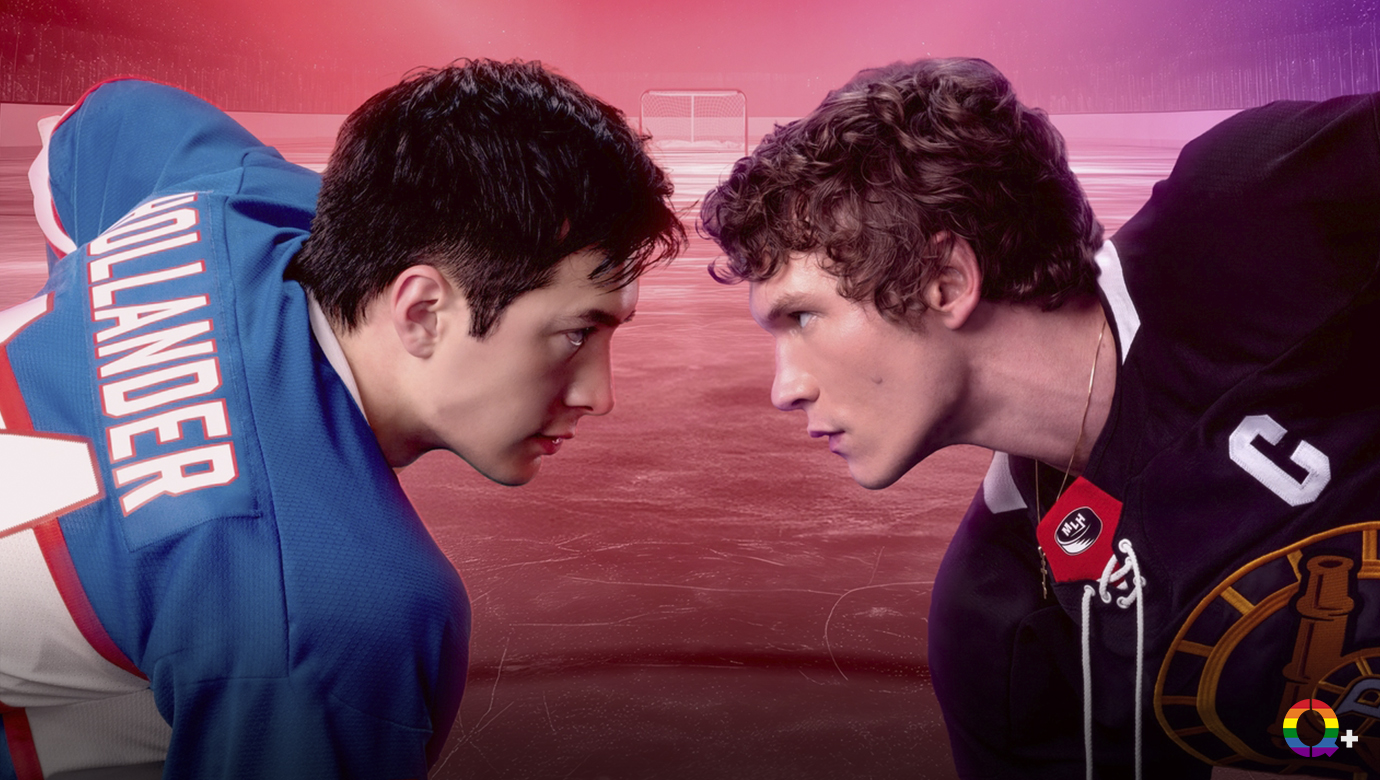
Heated Rivalry follows the story of Shane Hollander (Hudson Williams) and Ilya Rozanov (Connor Storrie), two elite hockey players whose on-ice rivalry masks a secret relationship stretching back years. But framing this show as a simple rivals-to-lovers sports romance would undersell what Season 1 actually achieves. This is a series about risk—of visibility, of loss, of wanting something that might reorder your life—and about the slow, often destabilizing process of choosing love without guarantees.
Under the guidance of creator and showrunner Jacob Tierney, Heated Rivalry emerges as a masterclass in adaptation done right. Translating Rachel Reid’s beloved novel to the screen was never going to be easy; the book lives deeply inside its characters’ internal worlds, with emotional beats that often unfold in quiet realizations rather than overt actions. Tierney understands this instinctively. Rather than forcing the story to conform to traditional television pacing, he reshapes the structure around emotional truth—expanding timelines, rearranging scenes, and letting silence do as much narrative work as dialogue.
What’s remarkable is how purposeful those choices feel. Changes aren’t made for convenience or grandiosity, but to sharpen the emotional spine of the story. Tierney clearly trusts both his audience and his source material. He understands what Heated Rivalry means to readers, and instead of diluting that intimacy for broader appeal, he leans into it. The result is an adaptation that feels reverent without being rigid, faithful to the spirit of Reid’s universe while confident enough to exist on its own terms.

That reverence for the source material is woven throughout the season. Fans of the Game Changers series will recognize the emotional DNA immediately: the slow burn, the humor threaded through intimacy, the way vulnerability is allowed to be awkward, tentative, and deeply sincere. But Season 1 also expands the world in meaningful ways, giving space to secondary characters and thematic threads that enrich the narrative without distracting from its core. It feels less like a direct translation and more like a dialogue between page and screen, each medium strengthening the other.
What makes Season 1 so compelling is its restraint. Rather than escalating conflict through constant upheaval, Heated Rivalry lets tension accumulate in silence, in looks held too long, in conversations carefully avoided. Early episodes establish the rhythm of Shane and Ilya’s connection as something stolen and conditional: hotel rooms, late nights, rules that are meant to keep feelings at bay. Their relationship is defined as much by what it excludes as by what it allows. The sex is explicit, yes, but never gratuitous. It functions as release, as escape, as something both men cling to precisely because they refuse to name what it’s attached to. Desire here isn’t freedom, it’s postponement.
As the season progresses, Heated Rivalry becomes increasingly interested in what happens when avoidance stops being sustainable. Episode by episode, the show peels back the armor both characters rely on. Shane’s meticulous self-control, shaped by family expectations and professional discipline, begins to crack under the weight of what he refuses to articulate. Ilya’s bravado, meanwhile—loud, flirtatious, deliberately excessive—slowly reveals itself as a survival mechanism born of loss, displacement, and the knowledge that love has never felt safe or permanent.

Crucially, the series never turns these into moral shortcomings. Shane’s hesitation is not framed as weakness, and Ilya’s intensity is never reduced to volatility for drama’s sake. Instead, Season 1 allows both men to be contradictory, frustrating, and deeply human. Their mistakes hurt, but they’re grounded in recognizable queer experiences: the terror of being seen, the exhaustion of secrecy, the longing for a future that feels impossible to plan for.
That emotional specificity would fall apart without performances capable of carrying it, and this is where Heated Rivalry truly excels. Hudson Williams’ Shane is a masterclass in micro-expressions and physical restraint. Every clipped response and rigid posture choice show how deeply Williams understands the inner workings of his character, turning restraint into a language of its own. Shane is a man who contracts, and Williams plays that internalized emotion with devastating consistency, making every crack in Shane’s composure feel momentous.
Opposite him, Connor Storrie’s Ilya is electric, charismatic, reckless, devastatingly vulnerable beneath the bravado. Ilya’s loudness is never empty; it’s intentional in the way survival often is. Storrie brings humor, sensuality, and excess to the role, but what lingers is the clarity of Ilya’s emotional exposure. The moments where he softens—where certainty gives way to ache, where confidence slips into longing—are some of the most emotionally resonant in the season. Where Shane contracts, Ilya expands, and Storrie understands this completely. His joy is infectious, his longing unmistakable, and his vulnerability devastating precisely because it’s so rarely unguarded.
Together, Williams and Storrie create a chemistry that feels less like sparks and more like gravity. Their connection isn’t about attraction alone; it’s about history. You feel the years between the characters, the patterns, the shared language, the unspoken rules built to survive each other. They don’t play falling in love; they play what it means to already be there and still refuse to say it out loud. Every glance feels loaded, every argument carries the weight it needs to. It’s a pairing that understands intimacy isn’t just about heat, it’s about recognition.
The true brilliance of Williams and Storrie’s performances lies in how completely they inhabit Shane and Ilya as both distinct individuals and a singular, evolving dynamic. Neither actor disappears into the relationship; instead, they bring their characters’ differences into sharper relief, allowing individuality to coexist with intimacy. Shane and Ilya don’t merge; they negotiate, collide, and recalibrate, moment by moment. That level of mutual understanding gives their scenes an almost hypnotic quality. You’re not just watching two characters fall into step; you’re watching two emotional systems learn how to function in the same space. It’s riveting, intimate, and quietly consuming in a way that makes it difficult to tear your eyes away from the screen.

Season 1 also understands that queer stories don’t exist in a vacuum. Through characters like Scott Hunter (François Arnaud), the show widens its lens to explore visibility in professional sports and the cost of being first. Scott’s decision to come out publicly isn’t treated as a universal solution or a narrative endpoint, but as one possible path—brave, meaningful, and still complicated. His storyline functions as representation within representation: a public act of truth that quietly reshapes the emotional landscape around it, influencing Shane and Ilya without prescribing their choices.
This thematic generosity is one of Jacob Tierney’s most significant contributions as adapter and showrunner. Rather than flattening Reid’s universe into a single narrative thesis, Tierney preserves its multiplicity. There is no singular model of queerness offered here, no prescribed timeline for authenticity; they all exist in constant negotiation with one another, and Season 1 never pretends otherwise.
The show’s craft supports this emotional range at every turn. Direction and editing favor stillness over visual noise, trusting viewers to sit with discomfort rather than rushing toward resolution. Music choices are deliberate and emotionally literate, often heightening intimacy rather than underlining plot. The pacing, especially in the latter half of the season, is confident enough to let entire scenes breathe without dialogue, reinforcing the idea that what Shane and Ilya don’t say often matters more than what they do.

All of this builds toward a finale that feels earned precisely because it doesn’t pretend everything is fixed. Episode 6, The Cottage, is less about grand declarations than it is about space: time carved out for honesty, domesticity, and the terrifying act of imagining a future together. When Shane and Ilya finally say the words they’ve been circling all season, it lands not as a twist, but as a release. Love, here, isn’t explosive; it’s steady, intentional, chosen.
The season’s final movements—particularly Shane’s coming out to his parents—are handled with rare emotional intelligence. Acceptance isn’t instant or performative; it’s quiet, uneven, and deeply personal. The show understands that coming out isn’t just about claiming truth, but about grieving the years spent withholding it. In allowing grief and hope to coexist, Heated Rivalry honors an experience many queer viewers know intimately.
By the time Season 1 ends, Shane and Ilya aren’t out to the world. Their future remains uncertain, shaped by careers, geography, and a league not built with them in mind. And yet, the season closes on something far more satisfying than resolution: commitment. Not a promise that everything will be easy, but a decision to stop running from what they feel.
By committing to this approach, Heated Rivalry Season 1 positions itself as both a complete emotional arc and a foundation for what’s to come. It doesn’t rely on cliffhangers or manufactured stakes. It trusts that the work it has done—building characters, honoring interiority, respecting queer experiences—will be enough to carry viewers forward. This is a series that understands queer love doesn’t need tragedy to be meaningful, nor perfection to be profound. Sometimes, the most powerful thing a story can do is let its characters choose each other and sit in that choice for a while.
Season 1 of Heated Rivalry isn’t just one of the most emotionally satisfying queer romances in recent television; it’s a testament to what happens when creators trust queer stories to be tender, complicated, and unapologetically sincere. It honors Rachel Reid’s universe, elevates it through thoughtful adaptation, and brings it to life through performances that feel deeply felt rather than performed.
In a genre that too often mistakes pain for depth, Heated Rivalry chooses something braver: it chooses patience, it chooses softness, it chooses care. And in doing so, it makes the case that the show’s global impact wasn’t a matter of chance, but rather a consequence of how thoughtfully it was made.
Season 1 of Heated Rivalry is available to stream on Crave (Canada), HBO Max (U.S. & Other Regions), Sky (New Zealand, UK), and Movistar Plus+ (Spain). Follow us on X and Instagram for all queer stuff!
Featured Image: Image Courtesy of Bell Media.
Discover more from Q+ Magazine
Subscribe to get the latest posts sent to your email.


Pingback: Heated Rivalry Episode 6: “The Cottage” — A Love So Big It Finally Has Room to Breathe – Q+ Magazine
Pingback: Rachel Reid Confirms Unrivaled: A Seventh Game Changers Book Is Officially Coming This Fall – Q+ Magazine
Pingback: Province of Canada Is Releasing the Heated Rivalry Fleece – Q+ Magazine
Pingback: Our Top 5 Hollanov Moments From Heated Rivalry Season 1 – Q+ Magazine
Pingback: Heated Rivalry Season 2 Expected to Start Production in August: Here’s the Latest Update – Q+ Magazine
Pingback: Jacob Tierney Heads to Netflix With Alexander, a New Historical Drama About Alexander the Great and Aristotle – Q+ Magazine
Pingback: 37th GLAAD Media Awards Celebrate LGBTQ+ Storytelling With Major Wins for Heated Rivalry, Stranger Things, and More – Q+ Magazine
Pingback: ‘Heated Rivalry’ Cast Speaks Out Against Toxic Fandom in Joint Statement – Q+ Magazine
Pingback: ‘Heated Rivalry’ Scores 18 Canadian Screen Awards Nominations – Q+ Magazine
Pingback: Heated Rivalry: The Unauthorized Musical Parody Sets Off-Broadway Run – Q+ Magazine
Pingback: 3rd Annual Celebration of LGBTQ+ Cinema & Television: Critics Choice Association Unveils 2026 Honorees – Q+ Magazine
Pingback: Television Academy to Recognize Heated Rivalry at 19th Television Academy Honors – Q+ Magazine
Pingback: Jacob Tierney Expands the ‘Heated Rivalry’ Universe with New Behind-the-Scenes Book – Q+ Magazine
Pingback: Heated Rivalry’s Viral Fleece Jacket Drops June 3 – Q+ Magazine
Pingback: Pride 2026: A Q+ Celebration – Q+ Magazine
Pingback: Heated Rivalry Wins Big at the 2026 Canadian Screen Awards, Sweeping Every Eligible Category and Making History – Q+ Magazine
Pingback: Attend the Premiere of Heated Rivalry Season 2: Here’s How Fans Can Enter This Incredible Sweepstakes – Q+ Magazine
Pingback: Heated Rivalry Soundtrack Scores Historic Billboard 200 Top 10 Debut – Q+ Magazine
Pingback: François Arnaud Is Turning Up the Heat as Under Armour’s New Global Ambassador – Q+ Magazine
Pingback: Heated Rivalry Season 2 casts Justice Smith and Charlie Gillespie as Harris Drover and Troy Barrett – Q+ Magazine
Pingback: Heated Rivalry Season 2 Casting: Edvin Ryding, Emily Hampshire, and More Join – Q+ Magazine
Pingback: Heated Rivalry Is Coming to Blu-ray, DVD and 4K UHD This Fall – Q+ Magazine
Pingback: 'Slo Pitch' Trailer Introduces Crave’s New Queer Softball Comedy – Q+ Magazine
Pingback: Heated Rivalry Season 2 Casts Daniel Diemer and Shaheen Jafargholi as Ryan and Fabian – Q+ Magazine
Pingback: Heated Rivalry Season 2 Confirms Returning Cast Members, Including Sophie Nélisse and François Arnaud – Q+ Magazine
Pingback: The Creators Behind Heated Rivalry Have Launched the Irina Foundation – Q+ Magazine