
Heated Rivalry Episode 6: “The Cottage” — A Love So Big It Finally Has Room to Breathe
The day has finally arrived. The season finale of Crave’s Heated Rivalry is here with Episode 6, The Cottage, and honestly? We’ve been waiting for this day like it was a national holiday. If you had told us a couple of months ago that during Christmas week we’d be more excited about a television episode than the actual festivities, we wouldn’t have believed you. And yet, here we are.
Because we don’t know about y’all, but this year things were different. Presents under the tree? Irrelevant. Family gathered around the living room? Background noise. The only thing that truly mattered was smashing play the second Episode 6 became available and screaming our way through it, decorum be damned.
And still, alongside that feral excitement, there’s something else sitting heavy in our chests: sadness. A bittersweet ache we weren’t fully prepared for, even after a full week of emotional pre-grieving. We thought we’d be ready to say goodbye to Season 1 of Heated Rivalry. Turns out, we absolutely are not.

In just five short weeks, this show has carved out a permanent place in our hearts. And now, realizing that there won’t be a new episode to look forward to next week leaves us feeling a little hollow. Heated Rivalry isn’t just a source of entertainment; it’s a safe space. It gives the LGBTQ+ community not only joy and representation, but something rare in queer television: a weekly ritual. A shared emotional language. A place where queer longing, intimacy, and happiness are allowed to exist without apology.
And knowing that Season 2 likely won’t arrive until early 2027 hurts a little. So we’re standing here at the end of Season 1 wishing we could stop time just a little longer, trying to savor everything this show has given us before reality sets back in. But time, unfortunately, refuses to cooperate. So instead, we have to embrace this finale with open arms and let the promise of Season 2 carry us forward.
Because that’s the good news, Heated Rivalry isn’t going anywhere. Despite detractors who never bothered to look past the graphic, spicy premise. Despite people who wish it hadn’t taken off the way it did. Heated Rivalry is here to stay. Not because of the sex, not because of the very attractive cast (although that certainly doesn’t hurt), but because it is a damn good television show. Period.

But let’s not get sidetracked, we’re here to talk about Episode 6, The Cottage, aka the most anticipated event of the year. Because yes, the moment Episode 5, I’ll Believe in Anything, ended with Ilya (Connor Storrie) accepting Shane’s (Hudson Williams) invitation to spend the summer at the cottage, this became a global event. We all RSVP’d. We all packed our bags. Ginger ale and Coke, good Russian vodka, condoms, lube, emotional-support snacks… you name it.
And while Episode 5 may still be the strongest of the season, Episode 6 is undeniably the sweetest. Fifty-one minutes of queer love and joy so concentrated we’re pretty sure we developed cavities just watching it. The Cottage understands that not every moment from the source material needs to be rushed to the screen. It’s willing to cut, to pause, to resist the urge to overdeliver before these characters are ready. Rather than chasing spectacle or shock, the episode commits to something far riskier: stillness. Space. Time. Hope. After five episodes defined by secrecy, stolen moments, and emotional whiplash, The Cottage asks a quieter, more dangerous question.
What happens when Shane and Ilya finally stop running from what they feel?
Let’s find out.

Episode 6: “The Cottage” — Stealing Time, Building Forever
Episode 6, The Cottage, opens about a month after the events of Episode 5, at the MLH Awards in June. Scott Hunter (François Arnaud) steps onto the stage to accept the league’s MVP award and immediately reframes the moment. Yes, he won the Cup a month ago, but something else happened that night, something that eclipsed even that victory: he came out. Publicly. Unavoidably.
Scott speaks with careful honesty, reminding the audience that he’s always been private, never one to share details about his personal life. But after seeing the reaction, especially the messages from young fans thanking him for the visibility, he feels compelled to open that door, even if just a little. He talks about loving hockey, about being grateful to do what he does for a living, while also acknowledging the uglier side of the sport: the slurs, the casual cruelty, the way queerness becomes a punchline.
Since he was a teenager, Scott realized he might be the very thing other players used as an insult, and that knowledge followed him everywhere. He talks about the exhaustion of keeping a secret, about how lonely that kind of vigilance can be. And then, Scott talks about the person who changed everything for him. The one who gave him the confidence, the strength, and the courage to be honest. Fear, he says, is powerful, but he found something stronger.
He dedicates the award to his teammates, but most of all to Kip (Robbie G.K.), crediting him for making him better in every possible way. This is what happens when truth is chosen over safety. This is what it looks like when love refuses to stay quiet. It’s moving, it’s unapologetic, and it sets the emotional tone for everything that follows.

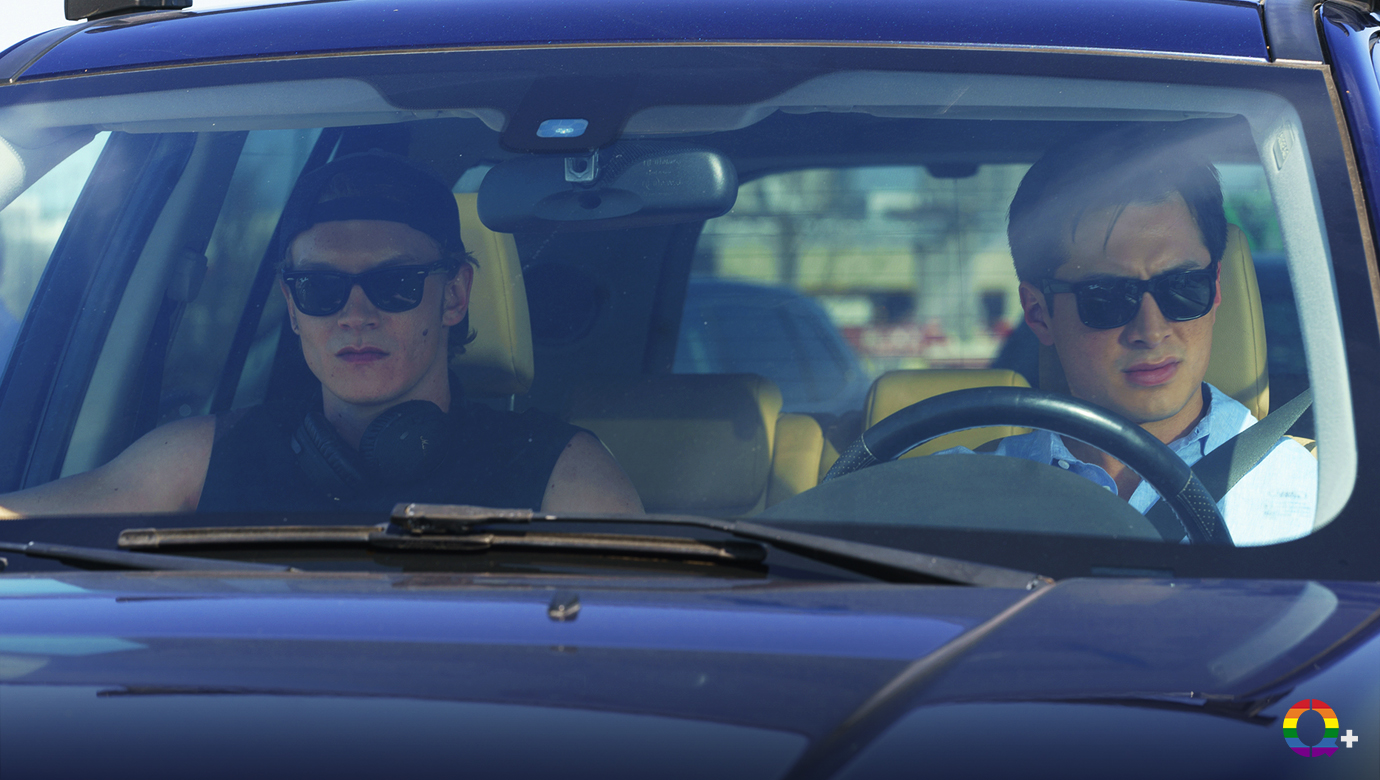
From that public declaration, The Cottage turns inward. July. Ottawa. Shane’s Land Rover waits in the airport parking lot, and Ilya climbs in, immediately clocking the car with mild disdain. Shane defends it with peak Canadian logic: it’s good in the snow. As music fills the air (a song choice that, like everything in this series, is anything but arbitrary), they drive in near silence. Not awkward, but weighted with nerves and anticipation, with the awareness that this is unfamiliar territory. They don’t do this, they don’t get uninterrupted time, they don’t allow themselves ease.
Shane fills the quiet, babbling a little, asking if Ilya’s hungry, offering to stop, explaining he bought groceries so they won’t have to leave the cottage much. He admits, softly, that he’s hoping they can actually relax together for once. Ilya thanks him for the invitation, admits he’s glad to be there, but also that he’s terrified. That feeling is mutual.
Shane reassures him that the cottage is private. No fans, no teammates, no parents—or so Shane claims, revealing he told his parents he’s on a silent meditation retreat. Ilya laughs at the ridiculousness of that lie, squeezes Shane’s hand, and just like that, they slip into a fragile, hard-earned bubble of bliss.
At the cottage, the nervous energy lingers. This is intimacy without an expiration date. No hotel sneak-outs, no excuses to leave. Shane rambles about buying Coke for Ilya, about giving him a tour around the house, until Ilya grounds him with a kiss. This, at least, they know how to do. They kiss, smile, tumble toward the couch, desperate and laughing until Shane stops, admitting he might not last long. It’s been months since the last time he had sex. Ilya admits it’s the same for him, a revelation that makes Shane beam.
Before things escalate again, Shane stops Ilya once more. This time, it isn’t nerves; it’s intention. He proposes something simple and terrifying: while they’re at the cottage, they both will try to be honest about everything, including feelings. They have time, two full weeks. That alone feels very dangerous.

What follows is pure domestic bliss. Bedroom negotiations unfold like flirtation disguised as logistics. Ilya demands a king-size bed, a view, and an ensuite. Each demand narrows the options until only Shane’s room remains. Shane, playing the polite bellboy, tells him it isn’t available. Ilya responds by throwing him onto the bed. They laugh and kiss. When Shane reaches for the remote to lower the blinds (there are a lot of windows in that cottage), Ilya stops him. He wants to be seen, fully. Exposure, in every sense of the word.
The days blur together into something soft and extraordinary. Too many Burgers on the grill, conversations about Shane’s parents, about each other. It’s ironic… they know so little about each other, despite knowing everything about one another. Shane admits his parents don’t know he’s gay, not because he thinks they’d reject him, but because his dating life has never been something he could safely explain. Ilya, blunt as ever, reminds him that coming out doesn’t require a list of sexual partners. Shane knows. Still, the weight is there because there’s no list, there’s only Ilya. And that truth is starting to demand space.
That night, they sit by a bonfire. Ilya questions the appeal of the activity, but Shane shrugs… sometimes you just sit and watch things burn. When Shane gets a text from Rose (Sophie Nélisse), Ilya’s jealousy flares. Shane quickly defuses it, admitting that the relationship was short, awkward, and deeply unfulfilling. Before he can elaborate, a loon cries out into the night, terrifying Ilya and derailing the conversation.
Shane laughs and mimics the sound of the bird. Ilya calls it a stupid Canadian wolf bird. They’re ridiculous, comfortable. Later, with Ilya’s head resting in Shane’s lap, the tone shifts. Ilya opens up about his family, about his mother, about finding her when he was twelve after an overdose. He talks about her strength and beauty, but also about her sadness. Shane listens, stunned and silent. Another loon cries into the night, and somehow, this shared grief feels safer under an open sky, so they stay out there. Some things deserve to be sat with.

Morning brings softness, confessions just shy of the words we’ve been waiting for. A video game, a phone call from Hayden (Callan Potter). Ilya’s relentless teasing escalates into something reckless and hot—a blowjob mid-call—and when Shane finishes the call, breathless and laughing, he makes sure Ilya understands something important: while risk and desire may have started this, it’s not what sustains it anymore. It hasn’t been for a while.
And that’s the quiet thesis of The Cottage. This isn’t about desire evolving into love; love has been there for years. This is love finally being allowed to exist.
When we see them again, Shane and Ilya are outside, barefoot and laughing, passing a soccer ball back and forth in the backyard. It’s casual in the way only stolen normalcy can be, and it’s here, in this easy rhythm, that Ilya lays the first stone toward their future: he’s been thinking about next season. He’ll be a free agent. Maybe he doesn’t re-sign with Boston, maybe he plays for a Canadian team instead. He talks about passports, about wanting options.
It’s another huge conversation disguised as small talk. Ilya is doing what he always does: floating something monumental into the air and watching how it lands. Shane listens, steady and quiet, absorbing the implications even as the ball keeps moving between them.
Later, inside the cottage, feet tangled on opposite ends of the couch, Ilya tries to set another stone in place. He says he could marry Svetlana (Ksenia Daniela Kharlamova), she’s American, influential, and willing to help. Shane freezes. It’s not subtle. He looks like he’s just been stabbed, all the air knocked out of him at once. So he asks the only question he can manage: Is she someone Ilya would actually want to marry?
Ilya shrugs it off. He and Svetlana are friends, so it would be fine, it would just be for paperwork. Shane, clearly spiraling, points out that Ilya likes women; maybe he could marry someone he actually wants to be with and solve both problems at once.
That’s when Ilya decides to twist the knife just a little… slowly., deliberately, playfully.

He admits he likes women. Everywhere he goes, he’s surrounded by beautiful women who adore him. Shane is miserable and barely masking it, but Ilya continues anyway, describing them as sexy and fun. And yet, there’s a problem. No matter where he is, no matter who he’s with, he’s always thinking about this slow hockey player with beautiful freckles and a weak backhand.
Shane smiles despite himself, pretending to be offended by the backhand. Ilya insists it is weak. He adds that he is also boring and drives a terrible car. Shane defends it again as a perfectly normal car. And through it all, the truth is unmistakable: Ilya is dismantling Shane’s fear piece by piece, even as Shane’s eyes go glassy with emotion.
Ilya finishes honestly: he wishes these women were Shane. It’s a terrible problem, the one he has. Shane, barely holding himself together, asks if Ilya wants that problem to go away. Ilya doesn’t hesitate: never. With unshed tears, Shane asks him not to marry Svetlana. They’ll figure something else out. Somehow.
That night, Shane can’t sleep because, of course, he can’t. This is who he is: the planner, the worrier, the one who lies awake rearranging the future until it feels survivable. Neither of them has said it yet, but it’s obvious: they’re both looking for ways to make this work. Whatever this is, it’s no longer casual. There is no returning to sporadic hookups and unspoken feelings.
He wakes Ilya with a plan.

Ottawa needs a center, they can afford Ilya. It’s only two hours from Montreal, close enough that they can see each other more often. Yes, Ottawa and Montreal would still be rivals, meaning they’d still face each other often, but it wouldn’t be the Metros and the Raiders. Not that kind of rivalry. They could start changing the narrative, let the younger players take over that mantle. They don’t have to carry it forever.
He keeps going. They could launch a charity together, something visible, something that makes it believable that they’re friends now. That way, if they’re seen together, it won’t look suspicious. Ilya could apply for Canadian citizenship. And maybe, someday, after they retire, they could be together for real. Out in the open.
Ilya asks if Shane really thinks that far ahead. Shane admits he does about this, about them. It’s forward-thinking in a way Shane rarely allows himself. When Ilya asks if being together is what Shane wants, Shane admits it is, so much so that it scares him. And that’s when Ilya breaks. Russian words spill out, emotion overwhelms him, and finally, he translates those words he’s said before: I love you.
Shane’s first response is a shocked, disbelieving ‘holy shit’—the kind of reaction that comes when a truth finally arrives without warning. But then he catches up to his own heart and tells Ilya he loves him too. So much.
What follows is one of the most tender and softest montages Heated Rivalry has ever given us. At sunrise, Ilya stands by the lake, wrapped in quiet. Shane approaches with two cups and a blanket, offering them to Ilya without a word. They sit together, watching the water, existing inside a moment that feels almost sacred.

Later, daylight pours into the bedroom as they make love again. They talk about how this became so big, how stupid and irresponsible they were to let it happen. Afterward, lying together, Shane asks about Ilya’s mother. Her name was Irina. Shane tells him about an idea he had: a hockey school, a summer camp for kids, with proceeds donated to mental health organizations and suicide prevention. Ilya is visibly moved and tells Shane that his mother would have loved him the way he loves him.
And yes, we absolutely lost our minds at that line. The romance, the implication that love doesn’t just heal forward, but backward, too. It’s devastating in the best way.
With their feelings finally out in the open, every exchange between them is loaded with adoration. They slip into the water, splash and laugh, unguarded and unafraid, wrapped in a bubble of happiness and freedom that feels almost unreal. Everything is soft. They’re so ridiculously in love that we want to stay in this moment forever.
But the universe, as always, has other plans. As they walk back toward the cottage, talking about food and the rest of their day, they’re caught kissing. Not by a fan, not by a teammate, but by Shane’s father, David (Dylan Walsh).
And just like that, the bubble bursts.

Shane stands frozen as his father walks away, the gravel crunching beneath David’s shoes louder than it has any right to be. He doesn’t chase him immediately, he doesn’t yell. Shane has never been someone who explodes on impact; he absorbs things, lets them settle somewhere deep inside, and processes later. This moment is no different, except that later feels unbearable. His chest tightens, panic creeping in slowly and then all at once. This is it. This is his worst nightmare unfolding in real time.
It’s Ilya who breaks through the spiral. He tells Shane that maybe it’s time to wake up. Shane admits what’s eating him alive: he’s lied to his parents for years about who he is and who he loves. He admits he’s terrified. But Shane doesn’t have to face this alone, not anymore, so Ilya offers to go with him, to stand beside him when Shane finally faces his parents.
Heated Rivalry then delivers one of the most emotionally resonant coming-out scenes we’ve seen on television in a long time. When Shane enters his parents’ home, his first instinct is not confession but reassurance, a quiet attempt to signal that he is still the same son they know. That reflex, the need to soften the moment before it even arrives, is painfully familiar to many in the LGBTQ+ community. Even before he explicitly comes out, Shane is already shrinking himself, trying to make the truth feel less disruptive, less threatening. It’s heartbreaking because it’s so real.
The mundanity of what follows only sharpens the tension. Shane’s father explains he stopped by for something as trivial as a forgotten phone charger, an ordinary reason that makes the weight of what’s about to happen feel even heavier. Shane admits he never wanted his parents to learn the truth this way, while his mother struggles to understand what’s unfolding in front of her.

And then Shane finally says it, simply, without spectacle or preparation. He is gay, and introduces Ilya as, well… the person he loves. Confusion and shock ripple across the room, particularly as his parents try to reconcile this revelation with everything they thought they knew, including Shane’s long-standing rivalry with Ilya. Shane doesn’t argue or defend himself; he acknowledges the surprise, apologizes for the timing, and asks for space, a chance for all of them to sit down and breathe through the moment together.
The four of them sit together, two couples facing each other around the table in a configuration that feels symbolic, whether anyone acknowledges it or not. Yuna (Christina Chang) and David admit they had long suspected Shane might be gay; they know their son. What catches them off guard isn’t his orientation, but who he’s with. Ilya’s presence shifts the room, turning curiosity into something more cautious, more loaded, and the history between them suddenly demands explanation.
They ask when it all began. Shane and Ilya hesitate, sharing a glance that says more than either of them is ready to articulate. David guesses the All-Star Game, mentioning their chemistry on the ice. Shane says it was way before that. Yuna presses for details, and Shane finally admits it’s been going on since their rookie season, though Ilya corrects him: the summer before.
Yuna struggles to process the implication of that length, of what it means to carry something like this for so long. Were they in love all that time? The answer isn’t simple or clean. Not love, not at first… something messier, harder to define, shaped by proximity, secrecy, and desire. It takes a moment for Yuna and David to fully understand what they’re being told, and in that pause, the weight of years of half-truths finally settles into the room.

Yuna breaks the tension first, announcing she needs a drink, and suddenly everyone does. Vodka appears—good Russian vodka—and for a brief moment, the room exhales. It’s an unexpected pocket of levity, a small but meaningful shift where curiosity replaces alarm, and the air becomes a little easier to breathe. The moment doesn’t erase what’s been said, but it softens it.
But questions keep coming. Do their teammates know? No, no one knows. Does Shane ever let Ilya win? Absolutely not, he’d rather be dead. But it’s David who asks the real question: Is the plan to stay together in secret until they retire? Probably. It’s a sad outcome, and Yuna names that sadness aloud. They all understand the constraints closing in around them: rival teams, a league built on manufactured narratives and selective tolerance, and a media ecosystem eager to turn their relationship into spectacle. What was possible for Scott Hunter, even at great personal cost, still feels impossible for them.
David brings up Ilya’s reputation as a notorious ladies’ man, and Ilya doesn’t bother disputing it. He’s been with many women, but he’s only ever loved one person. Shane mirrors the admission without hesitation. The clarity of it all is what finally overwhelms Yuna, who excuses herself, needing air.
Outside, Shane follows her, bracing himself for rejection that never comes. What hurts Yuna isn’t who her son is, but that he felt he had to hide it from her at all. The show takes a quiet but meaningful detour here—a private conversation between mother and son that isn’t in the book, but feels essential to this moment. It’s an additional scene that understands the emotional weight of coming out within a family: not just the fear of being known, but the grief of realizing how long someone has carried that fear alone.
When Yuna tells Shane she’s proud of him, the moment isn’t framed as triumphant or tidy. It’s raw, halting, and deeply human. They cry and hold each other. Heated Rivalry captures something painfully true about acceptance here: that it doesn’t always arrive loudly or perfectly, but it can still be profoundly healing. It’s a scene that reflects so many of our own experiences: the terror, the relief, the mourning of lost time, and the love that endures anyway.

Later, back at the table, Yuna is already in planning mode as they eat. Statements. Sponsors. Damage control. She’s thinking five steps ahead, trying to protect her son the only way she knows how. Shane asks her to stop. They’re not coming out, they just want a chance at a future.
Yuna turns her attention to Ilya, her gaze sharp and evaluative, and asks whether he would play in Ottawa. Ilya doesn’t hesitate: Yes. She presses further, probing what that choice would really mean, whether he would leave Boston for Shane. Again, the answer comes easily: Yes.
Shane recognizes the look on his mother’s face immediately. Yuna loves hockey more than anything, and for her, loyalty is important. Ilya’s willingness to walk away from Boston so cleanly unsettles her, reading less like devotion and more like a lack of commitment, so Shane steps in. Ilya isn’t being disloyal, he’s choosing to be loyal to him. And in that distinction, the episode quietly reframes what devotion looks like when love and career collide.
David asks whether they’ve spoken to Scott Hunter. Shane admits he hasn’t, but Ilya quietly reveals that he did, after the MLH Awards. He didn’t share their story or out them; he simply told Scott that what he did mattered, that it was brave. Ilya admits it changed things, not just for him, but for them.
The anxiety creeps back in for Shane almost immediately, familiar and sharp. Ilya notices before anyone else does. He grounds him, steady and certain, reminding him that he’s safe. His family is here, his boyfriend is here, they’re okay. They share a kiss, gentle and tentative, unguarded in a way they’ve never allowed themselves to be. Yuna and David watch quietly, exchanging glances as they piece together just how long this has been going on. Since their rookie season. No, the summer before. They smile, not in shock, but in understanding.
By the time Shane and Ilya leave, dinner plans have been made. The ordinariness of it all feels almost surreal. Their first coming out as a couple is over; the worst part is behind them. As they drive away, hands intertwined, the future remains uncertain. They aren’t out, not really, but in this very small, hard-won world, they are safe. And for now, that’s enough. It’s a closing beat so gentle and full of possibility, a reminder that happiness doesn’t always mean everything is fixed; sometimes it simply means you’re no longer alone.

We know some fans of the book will feel the absence of certain moments that didn’t make it into this finale. And that reaction makes sense. Heated Rivalry is a beloved text, and some scenes feel sacred. But as we said at the beginning of this piece, the series understands the emotional journey of these characters deeply. It knows when to hold back, when to reframe, and when to deliver—not based on fan expectation, but on where Shane and Ilya are right now. What the show chooses to omit isn’t erasure, it’s intention.
If this were the end of Heated Rivalry, it would still feel complete, not finished, but complete. A hopeful pause, a promise rather than a full stop. And that’s rare, queer love stories don’t often get to rest in tenderness and possibility, especially when the world around them hasn’t fully caught up. Knowing there’s more to come only deepens the resonance of where we leave Shane and Ilya here.
Because their journey is only just beginning. There’s still fear to face, feelings to unpack, distance to navigate, labels to wrestle with, and a future that refuses to be simple. But for the first time, they’re choosing each other, in private, in secret, but with intention. They’re in it for the long game. And if you know where their story goes next in Rachel Reid’s universe, you understand exactly how meaningful that promise is. This ending isn’t a conclusion. It’s a foundation.
What did you think of Episode 6, The Cottage? Did it completely wreck you the way it wrecked us? Let us know, and don’t forget to check out our full-season review of Heated Rivalry here. Because we’re not done talking about this show. Not even close.
Season 1 of Heated Rivalry is available to stream on Crave (Canada), HBO Max (U.S. & Other Regions), Sky (New Zealand, UK), and Movistar Plus+ (Spain). Follow us on X and Instagram for all queer stuff!
Featured Image: Image Courtesy of Bell Media.
Discover more from Q+ Magazine
Subscribe to get the latest posts sent to your email.


Pingback: Heated Rivalry Season 1 Review: A Queer Love Story That Refuses to Rush, Flinch, or Apologize – Q+ Magazine
Pingback: Our Top 5 Hollanov Moments From Heated Rivalry Season 1 – Q+ Magazine
Pingback: Heated Rivalry, Euphoria, RuPaul’s Drag Race and More Take Home Wins at the 23rd Gold Derby TV Awards – Q+ Magazine