To Love Out Loud: A Valentine’s Day Reflection
Every year when Valentine’s Day rolls around, we do what we always do: we make cheeky queer Valentine’s cards, we rank our favorite fictional couples, we build watchlists full of yearning glances and slow burns that could power entire cities. And we love doing that. Truly.
But this year, we wanted to do something a little different.
Because right now, loving out loud feels bigger than heart-shaped chocolates and red roses. We’re living in a world that often tries to politicize our existence, and in that climate, our love becomes radical, protective, almost sacred. Choosing to be unapologetically queer is how we safeguard it. It’s how we keep it alive.
We’ve spent the past few years watching something beautiful unfold across film, television, books, and even reality TV: our love stories are no longer confined to subtext, tragedy, or side plots. They’re epic and messy. They’re joyful and complicated. They’re centered, expansive, and perhaps most importantly, they’re universal.

Take the phenomenon around Heated Rivalry. What started as a beloved queer sports romance has grown into something bigger: an emotional collective experience that audiences across sexualities are connecting with. People aren’t tuning in simply because it’s a sexy queer story. They’re tuning in because it’s a great love story. The kind that makes you ache, that makes you sit in the tension, that makes you root not just for two people to be together, but for them to be truly happy.
And maybe that’s one of love’s most fundamental principles: choosing to want someone else’s happiness. Even when it’s complicated. Even when it challenges you. Even when it asks you to grow.
That’s the thing about queer love stories. The stakes often feel amplified because, for so long, we had to fight for the right to exist, let alone to love openly. So when we watch two women fall for each other on screen, or two men break down their emotional walls, or a nonbinary character find someone who sees them fully and correctly—it hits differently. It feels like reclamation. It feels like visibility. It feels like a quiet, hard-earned victory.
And increasingly, it feels normal. Queer love is no longer framed as spectacle or shock value. It is tender and human. We’ve seen it in teen romances that let young queer characters stumble, flirt, and mess up without their queerness being the tragedy. We’ve seen it in stories about trans joy, about chosen family, about second chances later in life. We see it in narratives that give queer characters the full range of emotion: desire, fear, longing, devotion, you name it.

Books have played a huge role in this shift. From beloved queer romances lining bookstore shelves to adaptations we’re eagerly anticipating, literature has become a sanctuary for expansive queer storytelling. We’ve been given rivals-to-lovers sagas, tender coming-of-age journeys, and sweeping historical romances where queer characters don’t just survive, they thrive. These stories prove something powerful: queer love is not a niche genre. It is a cornerstone of contemporary storytelling.
What’s been especially moving is watching audiences, queer and not, show up for these stories. They cry over them. They obsess over them. They create edits, write fanfiction, and debate character motivations with passionate intensity. And they do all of it because, at the end of the day, love written honestly transcends labels. It taps into something universal: the desire to be seen, to be chosen, to feel safe with someone.
But queer love on screen, on page, and in unscripted spaces doesn’t exist in a vacuum.

In a political climate where LGBTQ+ rights are debated like hypotheticals and our identities are treated like talking points, telling and supporting queer love stories becomes an act of resistance. Every ticket bought, every stream counted, every dog-eared paperback passed between friends, every show renewed, every queer couple that gets their happy ending carries weight. It all matters.
Because representation isn’t just about visibility. It’s about possibility.
When we see queer love portrayed as epic and worthy—when two rivals become soulmates, when friends become lovers, when hardened survivors choose tenderness—it reinforces something many of us already know but sometimes need reminding: our love is not secondary. It is not niche. It is not a trend or a footnote in someone else’s narrative.
It is powerful.
It is cinematic.
It is literary.
It is real.
And it is worth protecting.

This year, as we look ahead to the shows, films, and books we’ll be covering in the coming months—new seasons, long-awaited adaptations, bold indie films, fresh romance novels, stories from queer creators across the spectrum—we’re excited not just because of the content. We’re excited because each one is another reminder that our stories are expanding, growing, and pushing the boundaries of what we are allowed to be.
And yes, we’ll still scream over slow burns and argue about chemistry. We’ll still make our lists and our rankings and our chaotic group chats about who should’ve kissed in episode whatever. We’ll annotate our favorite passages and live-tweet shows like it’s a competitive sport. That joy, that obsession, that cultural participation, is part of what makes queer fandom feel like home.
But underneath all of that is something deeper.
Love in queer spaces has always extended beyond romance. It lives in chosen family and community care. It shows up in holding hands at Pride and in showing up to vote. It exists in supporting queer authors and queer-led productions, in checking on your trans friend when the news gets heavy, and in creating art that tells the truth about who we are. It is the quiet promise that none of us have to navigate this world alone.
Choosing love, especially now, is not naive. It is intentional. It is defiant. It is hopeful.

So this Valentine’s Day, we’re celebrating the grand gestures and the soft ones. The rivals-to-lovers arcs and the quiet domestic scenes. The first kisses and the decades-long partnerships. The fictional couples we’d defend with our lives and the real-life love that sustains us every day.
Because at its core, love is about wanting someone else’s happiness as fiercely as your own. And in queer spaces, where happiness has so often been hard-won, that choice feels revolutionary.
We will always celebrate the ships. We will always hype the releases. We will always champion the stories that center us. But today, we’re also celebrating something bigger: the simple, radical fact that our love stories exist at all. That they’re being told loudly. That they’re being received with open hearts. That they are quietly, steadily changing the world simply by being honest.
Love has never been small.
And neither are we.
Happy Valentine’s Day, from all of us, to all of you.
Follow us on X and Instagram for all queer stuff!
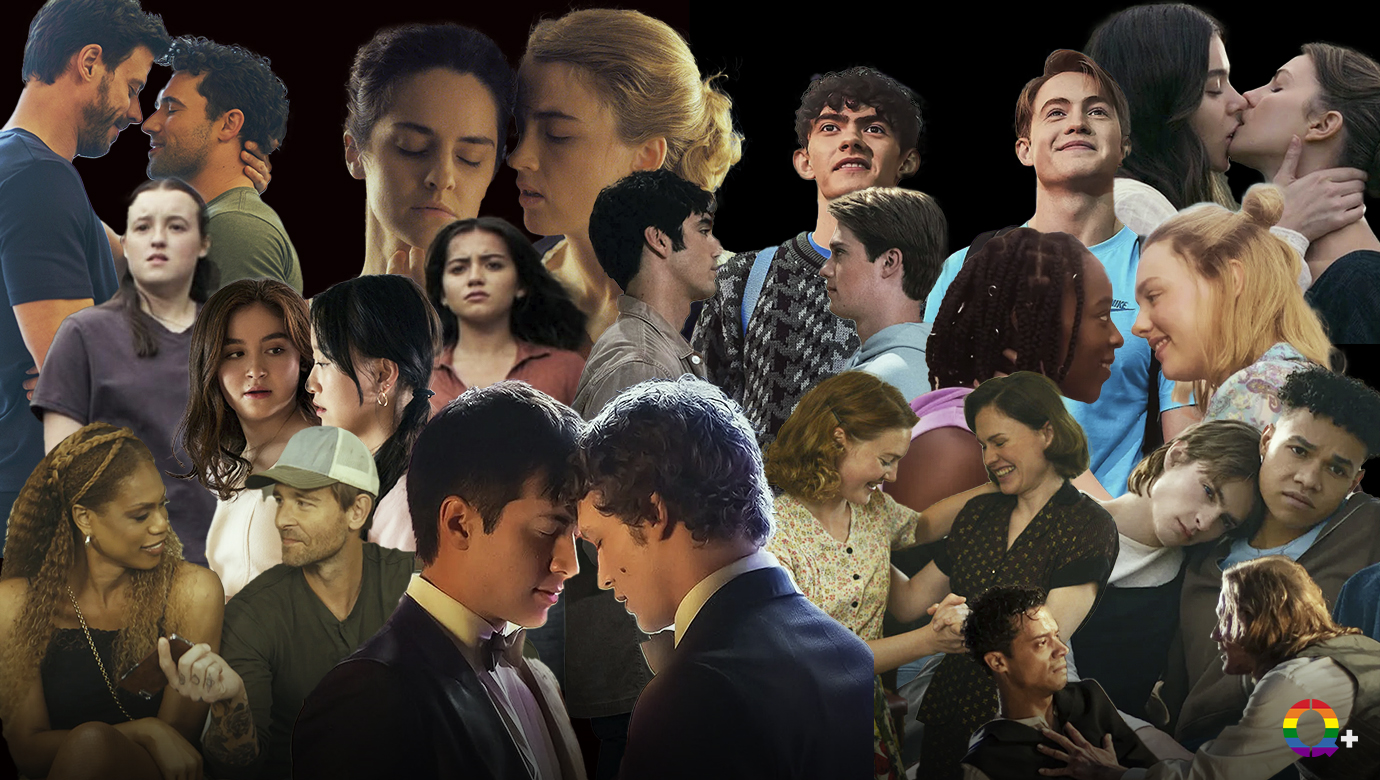
Featured Image: Images Courtesy of Netflix, HBO Max, Focus Features, Apple TV, Amazon MGM Studios, Lionsgate, Lilies Films


