Identity Isn’t a Box—and Olivia Colman’s Words Remind Us Why
Identity isn’t fixed, and it certainly isn’t one-size-fits-all. For many of us, it shifts, evolves, and resists the boxes society tries to place us in, especially when it comes to gender. The binary has long dictated how people are expected to move through the world, but more and more voices are speaking up about how limiting that framework can be. Recently, Olivia Colman added her own reflections to that conversation in a way that felt honest, personal, and intentionally unlabelled.
While promoting Jimpa, which recently premiered at Sundance, Olivia Colman sat down with Them for an interview that quickly expanded beyond the film and into a thoughtful, vulnerable conversation about gender, community, and belonging. When asked about her long history of working on LGBTQ+ stories—from The Favourite to Heartstopper and Beautiful People—the Academy Award-winning actor spoke candidly about why queer narratives feel like home to her.

“I think it’s a community that I love being welcomed into,” Colman said. “I find the most loving and the most beautiful stories are from that community. And I feel really honored to be welcomed.”
That feeling of welcome seems inseparable from how Colman understands herself. As the conversation continued, she shared that this sense of alignment with queer spaces isn’t new. “Throughout my whole life, I’ve had arguments with people where I’ve always felt sort of nonbinary,” she explained, before immediately adding an important boundary: “Don’t make that a big sort of title! But I’ve never felt massively feminine in my being female.”
That clarification matters. In a media landscape that often rushes to label, categorize, and headline-ify someone’s identity, Colman’s words remind us that self-understanding doesn’t always come with a name tag. She went on to offer more insight into how she’s long described herself in private. “I’ve always described myself to my husband as a gay man,” she said, noting that his response was simply, “Yeah, I get that.” Colman added, “And so I do feel at home and at ease. I feel like I have a foot in various camps.”

Rather than declaring an identity, Colman was describing a feeling, a lifelong sense of not fully fitting into the expectations attached to womanhood, and of finding comfort among people who exist outside rigid norms. Jimpa director Sophie Hyde echoed that sentiment, pointing to the limitations of gender socialization. “We’re raised as women, we’re socialized as women, but that doesn’t mean that that’s not a limiting idea for us,” Hyde said, “The idea of being a woman or womanhood. It doesn’t necessarily fit for all of us. And I think these binaries of gender are problematic for many of us.”
Colman agreed, expanding the conversation beyond her own experience. “Men are limited, too, in that, in the expectation they have to live up to,” she said. Reflecting on her marriage, she added, “With my husband and I, we take turns to be the ‘strong one,’ or the one who needs a little bit of gentleness. I believe everyone has all of it in them.”
What makes Olivia Colman’s words so meaningful isn’t a label or a headline; it’s the way she names a shared human experience. “I’ve always felt like that,” she said. “And it’s only now, and talking to Aud and their community, suddenly I’m not an oddity.”
That recognition—that you’re not alone, that there’s language and community for feelings you’ve always carried—is something many LGBTQ+ people understand intimately. Colman’s words don’t demand definition; they invite conversation. And that, in itself, is powerful.
To read the full conversation with Olivia Colman and Sophie Hyde, including their discussion of Jimpa and the ideas behind it, we encourage you to check out the complete interview with our friends at Them. It’s a thoughtful, expansive piece that deserves the time and attention.
Follow us on X and Instagram for all queer stuff!
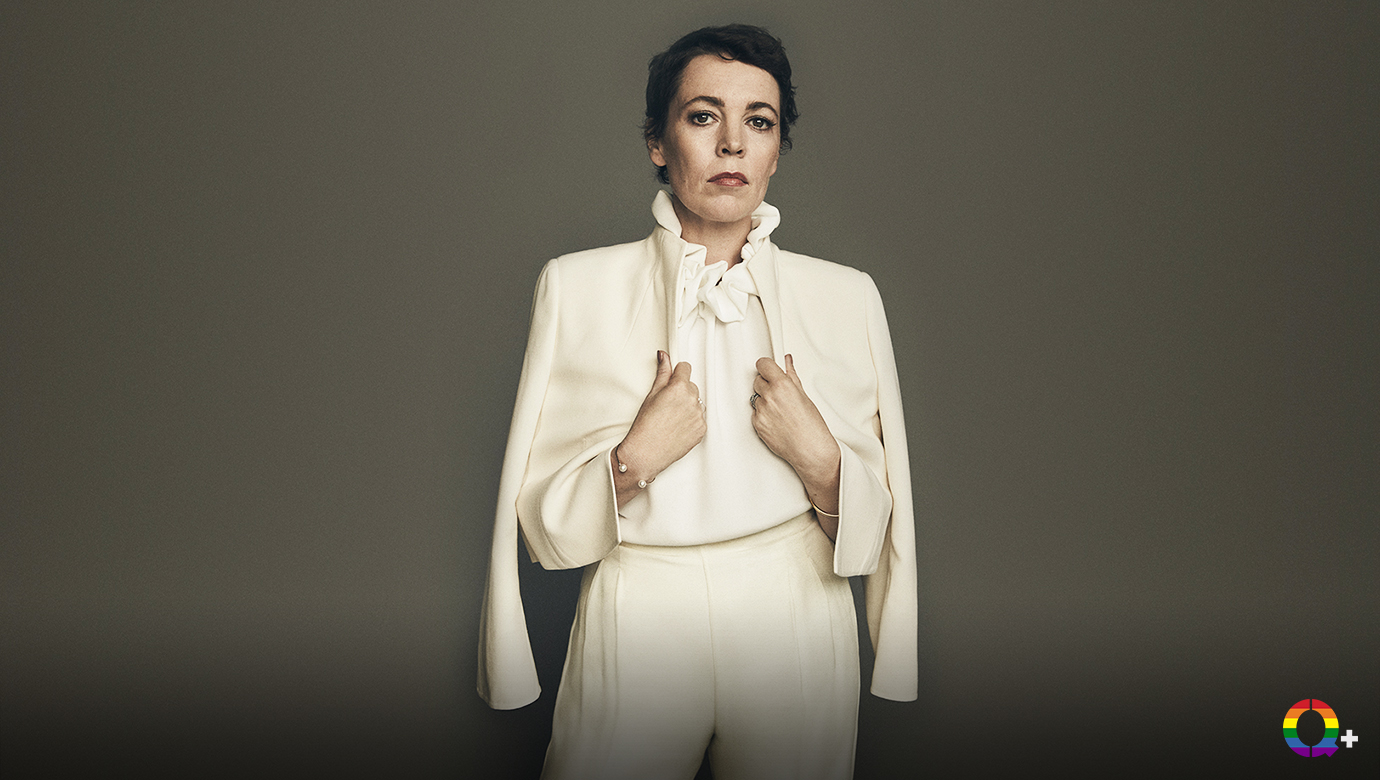
Featured Image: Image via AUGUST. Photo by Miller Mobley.


