
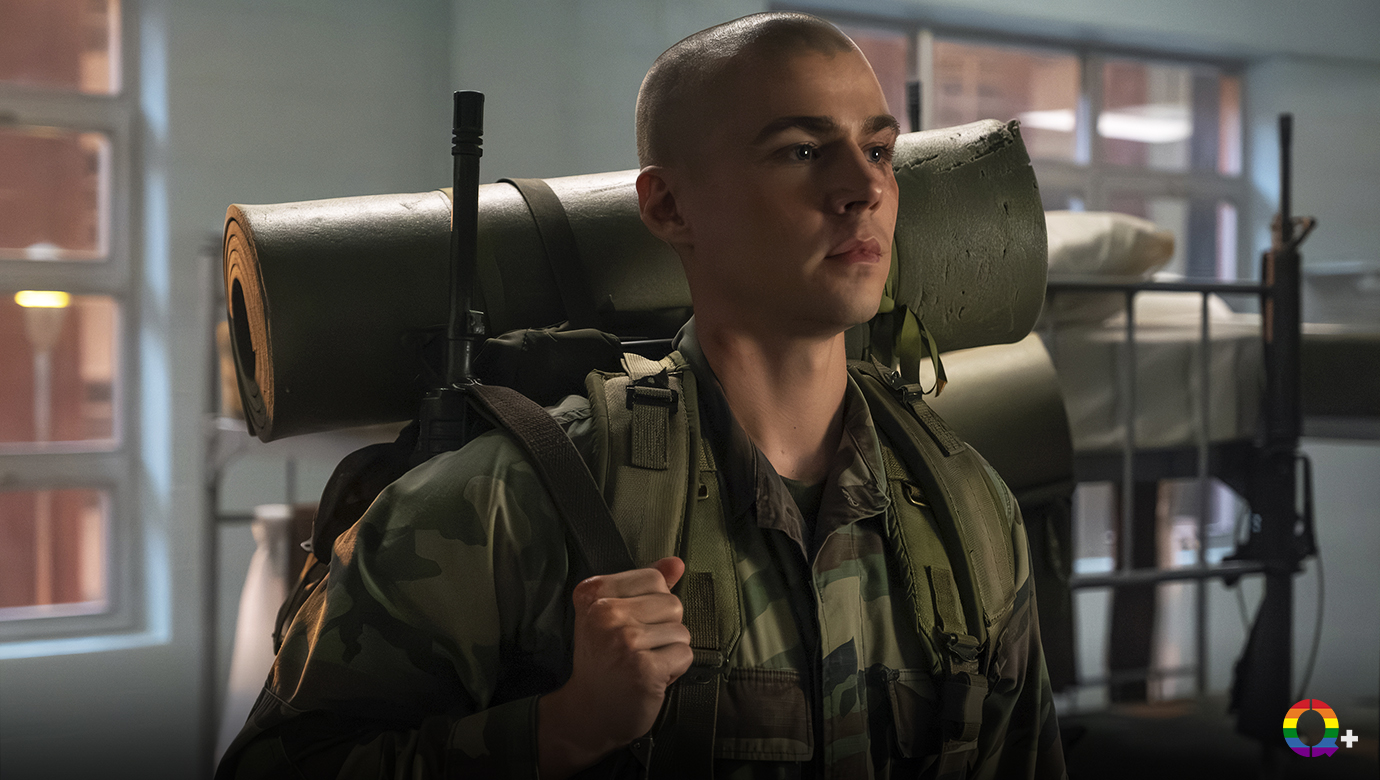
Boots Review: Netflix’s Military Dramedy Marches Through Queer History With Heart and Humor
The march into queer history has rarely looked quite like this. Netflix just released its new and highly anticipated dramedy Boots, and we can’t deny that we really loved this one. Boots is a sharp, funny, and unexpectedly moving story that reimagines what it means to serve, survive, and self-define under impossible circumstances.
Based on Greg Cope White’s memoir The Pink Marine: One Boy’s Journey Through Bootcamp to Manhood, the eight-episode series follows a young gay man’s journey through U.S. Marine Corps training in 1990—just years before “Don’t Ask, Don’t Tell” reshaped (and silenced) the conversation around queerness in the military.
While White’s memoir detailed his own bootcamp experience in 1979, the show’s creative team, led by writer and showrunner Jennifer Cecil, pushes the timeline forward. It’s a clever shift. By setting the story just before the DADT policy took effect in 1994, it allows the series to explore the quiet yet perilous reality of LGBTQ+ service members living in secrecy during a time when simply being themselves could destroy their lives.
From the first episode, Boots feels like it’s doing something bigger than just adapting a memoir. It’s honoring a slice of LGBTQ+ history that’s rarely dramatized, and it’s doing so with a mix of humor, vulnerability, and quiet defiance. But we’re getting a bit ahead of ourselves. Let’s talk about what Boots is actually about.
(Spoiler alert: from this point forward, we’ll discuss key storylines from Season 1, but we’ll avoid giving everything away. Either way, tread carefully.)

What Boots Is About
Boots follows 18-year-old Cameron Cope (Miles Heizer), who joins the Marines to follow his best friend, Ray McAffey (Liam Oh). From the moment we meet him, Cameron is wrestling with the feeling that he’s living as two people: the version everyone sees—quiet, bullied, unsure—and the one he hides deep inside, the part of himself that knows exactly who he is.
The show takes that internal divide literally, letting Cameron’s imaginary double appear beside him to offer advice, judgment, and sometimes a bit of sass. Think Lizzie McGuire’s cartoon alter ego, but with military buzzcuts and existential dread—a clever device that adds both humor and emotional weight.
Cameron’s life feels stalled. He can’t afford college, his family dynamic is as complicated as it’s always been, and he’s desperate for direction. When Ray tells him he’s leaving the Air Force Academy to join the Marines, Cameron decides to follow him, drawn by the promise that friends who enlist together can stay in the same platoon through boot camp. It sounds simple enough— like a summer camp in camo—except for one critical detail: in 1990, being gay in the military was still illegal, and Cameron is very much gay.
Ray is the only one who knows his secret, though, and while he insists Cameron will be fine if he keeps his head down, we understand the stakes are far higher. To give y’all a bit of context, before DADT was implemented in 1994, the U.S. military enforced a total ban on homosexual service members. Queer individuals could be denied entry, dishonorably discharged, or even court-martialed under Article 125 of the Uniform Code of Military Justice, which criminalized consensual same-sex intimacy. Investigations could include interrogations, searches for letters or diaries, and relentless humiliation. For Cameron, every moment of boot camp is shadowed by that very threat.

When the recruits arrive at Parris Island, South Carolina, their illusions about adventure and purpose evaporate instantly. Senior Drill Instructor Staff Sergeant McKinnon (Cedrick Cooper) and his team—Sergeants Knox (Zach Roerig) and Howitt (Nicholas Logan)—waste no time breaking them down. The bootcamp experience is depicted with punishing authenticity: sleepless nights, 5 a.m. wakeups, relentless drills, and the constant stripping away of individuality until all that’s left is uniform obedience. Drill instructors rely heavily on intimidation, psychological pressure, and harsh language. The purpose, at least in theory, is to build discipline and strength, but the line between training and trauma is razor-thin.
Just when the recruits think they’ve adjusted, they meet Drill Instructor Sergeant Sullivan (Max Parker), whose arrival as Sergeant Knox’s replacement changes everything. Intimidating and enigmatic, Sullivan pushes them harder, demands more, and runs the platoon with unnerving precision. Whereas Knox was punitive, Sullivan seems more calculating, more watchful, and more intimate. It’s through this dynamic, and the slow unveiling of his own guarded history, that Boots finds some of its deeper emotional stakes.
As the weeks pass, we see Cameron’s resolve tested in every possible way. He faces humiliation, exhaustion, and moments of doubt, yet he also finds flickers of friendship and resilience in unexpected places. Boots thrives in these smaller moments—the camaraderie between recruits, the laughter that sneaks through the cracks, and the sense of shared endurance that slowly begins to form.

A Story Beneath the Surface
Among Boots’ many threads, one in particular lingers long after the final episode. Without giving too much away, there’s a character—a man in command—who, like Cameron, is carrying more than he can say aloud: he’s gay. But unlike Cameron, he’s lived most of his life in secrecy, burying parts of himself to survive within a system built on conformity.
As the show unfolds, fragments of his past emerge, letting us see a forbidden relationship, a betrayal, an investigation he once denied involvement in, and the guilt that follows him still.

The way the series handles this storyline is striking. It never sensationalizes his identity or paints his secrecy as cowardice. Instead, it shows how institutions force people to become shadows of themselves, to wear armor that doesn’t come off even when the uniform does. How the military can twist love into shame, and duty into denial.
His presence becomes a reflection of Cameron’s own journey: one man at the beginning of his story, another haunted by the choices he’s already made. That quiet, unspoken parallel is one of Boots’ most powerful emotional beats.
This storyline, quietly devastating in its simplicity, stuck with us more than almost anything else. It’s a reminder that every generation of queer people has its own version of the closet and that freedom, for some, comes too late.

Courage, Identity, and Belonging
What makes Boots so compelling is how it balances its emotional core with moments of sharp humor and humanity. The show doesn’t just depict queer struggle; it celebrates queer resilience: the strength found in friendship, the dignity of survival, and the courage it takes to exist authentically in a world that demands the opposite.
The recruits aren’t villains or saints; they’re scared kids trying to figure out who they are in an environment that leaves no room for softness. The writing acknowledges the contradictions of masculinity, how the same system that teaches courage can also breed cruelty, how “brotherhood” can both protect and destroy.
There’s humor, tenderness, and a sense of community that feels deeply earned. The friendships that form under duress—between recruits who start as rivals and end as brothers—give Boots its beating heart. By the time the final episode rolls around, we’re reminded that survival itself is an act of rebellion, and that chosen family can emerge in the unlikeliest of places.

At its heart, Boots is about a young man deciding who he wants to be when every system around him insists he has no choice. That message feels especially poignant today, as we watch hard-won LGBTQ+ rights once again come under threat. The parallels between the series’ early ’90s setting and our current political climate are impossible to ignore, and Boots embraces that tension with grace rather than despair.
Miles Heizer anchors the series with a career-best performance. His Cameron is both vulnerable and quietly defiant, never the stereotype of a “tragic gay lead,” but a full, complicated person learning to take up space in a world that keeps trying to shrink him. Liam Oh gives Ray a natural loyalty and presence that grounds the story, balancing charm with frustration, giving depth to a character who could easily have been a one-note sidekick.
And then there’s Max Parker as Sergeant Sullivan. Without spoiling too much, Parker’s performance is all restraint—a man whose silence says more than dialogue ever could. He brings humanity to a character who might otherwise have been reduced to authority, turning him into one of Boots’ emotional anchors.
The supporting cast—including Cedrick Cooper, Ana Ayora, Rico Paris, Johnathan Nieves, Vera Farmiga, Angus O’Brien, Kieron Moore, Nicholas Logan, Dominic Goodman, Blake Burt, Sachin Bhatt, Brandon Tyler Moore, Jack Kay, and Troy L. Johnson—rounds out an impressively cohesive ensemble. Even characters who appear briefly leave their mark, helping to create a world that feels textured and alive.

A Reflection of Then and Now
Though Boots is set more than three decades ago, it feels painfully current. As LGBTQ+ rights face renewed attacks across the U.S., the series lands like both a history lesson and a warning. It asks us to remember a time when queer people risked everything for authenticity, and to question how far we’ve really come.
It speaks to the parts of queer history that too often go unacknowledged—the fear, the invisibility, the small acts of defiance that made survival possible. Yet it also speaks to the present, where rights and recognition once thought secure are being questioned, rolled back, or outright attacked at alarming speed.
The show doesn’t pretend that bravery always looks like heroism. Sometimes it’s just choosing to keep going, to stay, to try. And sometimes it’s telling the truth, even if only to yourself.

Boots may be fiction, but it’s built from truths that echo across generations. It captures stories that live in countless veterans, in families, in memories too heavy to retell. It’s a moving, sharply written series that balances humor and heartbreak with equal skill, and one that reminds us why representation still matters, especially when the fight for visibility feels like it’s beginning all over again.
So lace up, because Boots isn’t just a show about the Marines. It’s a salute to queer resilience, a reclamation of courage, and a reminder that visibility—even when it comes in whispers—can still echo like a battle cry. And as we look at where we are now, we can only hope it remains a portrait of what once was, not a preview of what could be again.
Boots is available to stream on Netflix now. Follow us on X and Instagram for all queer stuff!
Featured Image: Image Courtesy of Netflix.


Pingback: Between the Warrior and the Lover: A Look Into Sergeant Sullivan from 'Boots' – Q+ Magazine
Pingback: Boots Cancelled at Netflix—Another Queer Story Cut Short – Q+ Magazine
Pingback: The 37th Annual GLAAD Media Awards Nominees Are Here – Q+ Magazine